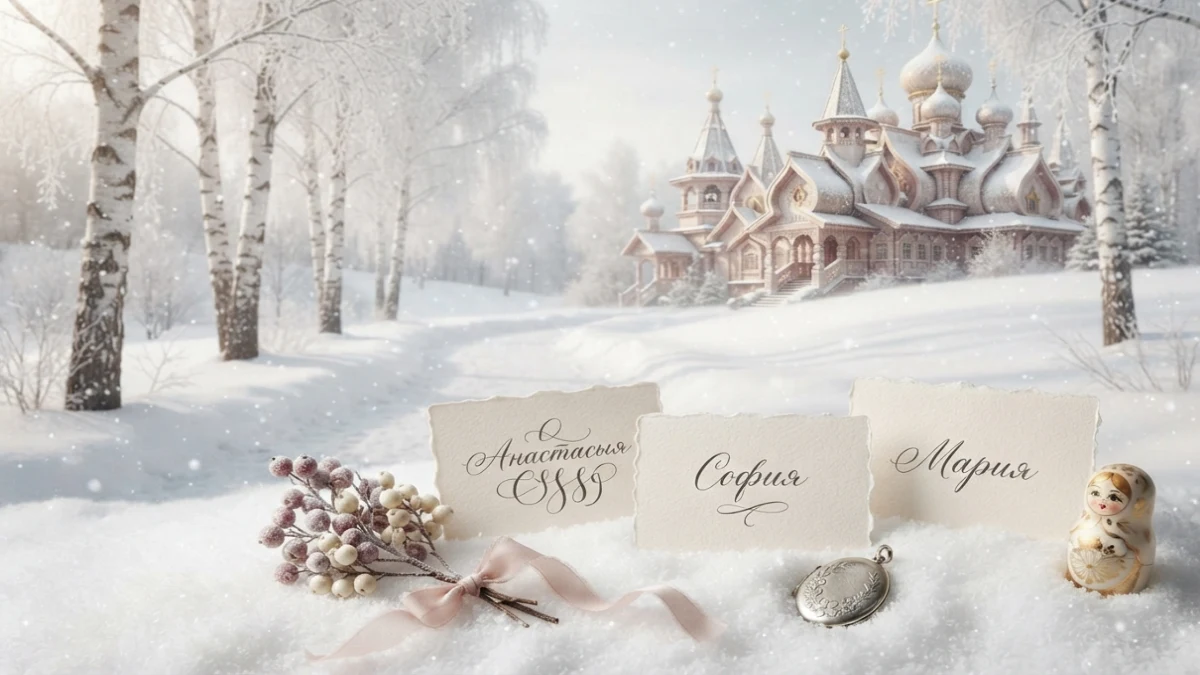
Russian girl names have a distinctive kind of beauty. Some feel soft and romantic; others carry an unmistakable sense of strength, history, or mystery. A name such as Anastasia can feel elegant and timeless, while Svetlana has a luminous quality, Lyudmila feels literary and traditional, and Zlata brings a brighter, more unusual Slavic character.
If you’re searching for a Russian girl name for a baby, fictional character, story, game, or simply for inspiration, the best choice is rarely the name with the most elaborate meaning. It is the name whose sound, cultural history, personality, and everyday usability fit what you imagine.
Russian naming also has an important distinction between formal names and affectionate short forms. Anastasiya can become Nastya, Mariya can become Masha, Yekaterina can become Katya, and Sofiya can become Sonya. That flexibility gives many Russian names an appealing two sided personality: formal when needed, intimate at home.
Featured snippet:
Some especially appealing Russian girl names include Anastasia, Sofia, Yelena, Yekaterina, Darya, Irina, Vera, Svetlana, Lyudmila, Olga, Alina, Arina, Zlata, Milana, and Aleksandra. They range from classic and Orthodox associated names to modern, international, and distinctly Slavic choices.
The “prettiest” name is subjective, so the most useful way to choose is by vibe: soft, elegant, regal, mysterious, traditional, modern, or rare.
Russian girl names at a glance
| Name | Meaning / origin | Pronunciation | Overall vibe | Style |
| Anastasia | Greek; “resurrection” | ah nah STAH see yah | Romantic, graceful | Classic |
| Sofia / Sofiya | Greek; “wisdom” | so FEE yah | Refined, intelligent | Classic modern |
| Yelena | Russian form of Helen | yeh LEH nah | Elegant, luminous | Classic |
| Yekaterina | Russian form of Katherine | yeh kah teh REE nah | Regal, polished | Traditional |
| Darya / Daria | Persian/Roman historical roots; form of Daria | DAHR yah | Confident, feminine | Classic modern |
| Irina | Greek; associated with “peace” | ee REE nah | Calm, sophisticated | Classic |
| Vera | Russian word for “faith” | VEH rah | Simple, strong | Classic |
| Svetlana | From Russian svet, “light” | svet LAH nah | Radiant, poetic | Distinctive classic |
| Lyudmila | Slavic; “dear/gracious to the people” | lyood MEE lah | Literary, warm | Traditional |
| Olga | Old Norse/Varangian origin; associated with “holy” | OHL gah | Strong, dignified | Historic |
| Aleksandra | Greek; feminine form of Alexander | ah lek SAHN drah | Powerful, sophisticated | Classic |
| Zlata | Slavic; “golden” | ZLAH tah | Bright, luxurious | Slavic |
| Arina | Russian form/variant of Irina | ah REE nah | Soft, contemporary | Modern |
| Milana | Slavic name associated with mil, “gracious/dear” | mee LAH nah | Feminine, fashionable | Modern |
| Nadezhda | Russian/Bulgarian; “hope” | nah DEZH dah | Serious, meaningful | Traditional |
Etymologies above refer to established linguistic or historical explanations; the “vibe” and style descriptions are editorial interpretations rather than literal meanings.
How Russian girl names work
One of the most charming features of Russian naming is the difference between a person’s formal name and familiar forms.
A child may officially be Mariya, but family and friends may call her Masha or Marusya. Yekaterina can become Katya, Anastasiya can become Nastya, and Sofiya can become Sonya. These forms are not simply random nicknames; Russian has a rich tradition of diminutives and affectionate name forms.
This is useful when choosing a name because you are effectively selecting more than one sound:
formal name → everyday short form → affectionate form
For parents, that means a name can feel elegant on a birth certificate while remaining warm and playful in family life.
A note on transliteration
You may encounter several spellings of the same Russian name.
For example:
- Екатерина → Yekaterina / Ekaterina
- Елизавета → Yelizaveta / Elizaveta
- София → Sofiya / Sofia
- Анастасия → Anastasiya / Anastasia
- Дарья → Darya / Daria
The difference often reflects transliteration choices rather than completely different names.
Classic Russian girl names

Classic Russian names tend to have the greatest sense of historical continuity. Many entered Russian usage through Greek, Hebrew, Latin, Germanic, or other European traditions and became deeply established in Russian culture.
1. Anastasia
Meaning: “resurrection”
Origin: Greek
Russian form: Anastasiya
Nickname: Nastya
Anastasia is graceful without being fragile. Its long, flowing sound gives it a romantic quality, while the name’s historical Christian associations give it depth.
It also has strong cultural recognition outside Russia, making it one of the easiest Russian associated names to use internationally.
Vibe: graceful, intelligent, romantic, quietly glamorous.
Best for: parents wanting a traditional name that still feels beautiful internationally.
2. Sofia
Meaning: “wisdom”
Origin: Greek
Russian form: Sofiya / Sofya
Nickname: Sonya
Sofia has a particularly polished sound. It works beautifully in Russian speaking contexts while also being immediately recognizable internationally.
The Russian diminutive Sonya adds warmth and familiarity. Sonya also has a literary connection through Leo Tolstoy’s War and Peace.
Vibe: intelligent, elegant, composed.
Aesthetic: quiet luxury, classic literature, understated sophistication.
3. Yekaterina
Meaning: Russian form of Katherine
Origin: Greek through Katherine traditions
Nickname: Katya
Yekaterina feels grander than many shorter Russian names. It has an unmistakably formal, regal quality.
The name has a major historical association with Catherine the Great, who was born Sophie of Anhalt Zerbst and adopted the Russian name Yekaterina when she entered the Russian imperial and Orthodox world.
Vibe: regal, intelligent, commanding, refined.
Best for: a character or child name with an old world, aristocratic feeling.
4. Yelena
Meaning: Russian form of Helen
Origin: Greek
Nickname: Lena
Yelena has a softer presence than Yekaterina. It sounds graceful and mature without becoming overly formal.
The short form Lena also travels easily across languages.
Vibe: luminous, feminine, composed.
Aesthetic: candlelight, classical art, understated elegance.
5. Irina
Meaning: associated with “peace”
Origin: Greek
Russian form: Irina
Irina is one of those names that feels sophisticated without trying too hard. Its short length makes it practical, while its traditional roots give it substance.
Vibe: calm, intelligent, graceful.
Social impression: polished and mature rather than whimsical.
Soft and romantic Russian girl names

If your ideal name sounds like something from a winter novel, a ballet, a vintage photograph, or a love story, consider names with softer consonants and flowing vowel patterns.
| Name | Emotional tone | Why it stands out |
| Anastasia | Romantic | Long, elegant, internationally familiar |
| Sofiya | Refined | Connected with wisdom and literature |
| Yelena | Luminous | Soft sound and strong international usability |
| Alina | Delicate | Short, smooth, contemporary |
| Arina | Gentle | Russian variant associated with Irina |
| Milana | Feminine | Modern Slavic feel |
| Lyubov | Deeply romantic | Literally connected with “love” |
| Vera | Quietly emotional | Directly means “faith” in Russian |
| Svetlana | Poetic | Built from svet, “light” |
| Liliya | Floral | Russian form related to Lily |
Lyubov
Lyubov is particularly meaningful because it comes from the Slavic element associated with love. Its diminutive Lyubochka creates a much softer, affectionate feeling.
Unlike a name chosen merely because it sounds pretty, Lyubov carries an unusually direct emotional idea.
Vibe: devoted, tender, heartfelt.
Strong and elegant Russian girl names
Not every beautiful Russian name is delicate. Some have a firm, authoritative sound that works particularly well for strong female characters or parents seeking a name with presence.
Aleksandra
Meaning: feminine form of Alexander
Origin: Greek
Nickname: Sasha / Shura
Aleksandra balances strength and femininity exceptionally well. The connection with Alexander gives the name a long standing association with protection and power.
The short form Sasha makes the name dramatically more casual and approachable.
Vibe: capable, confident, intelligent.
Olga
Origin: Old Norse/Varangian
Historical association: Saint Olga of Kyiv
Olga is an especially interesting example of how a name can become deeply embedded in Russian culture despite having an earlier Scandinavian linguistic origin.
The Orthodox Church in America identifies Olga with the Varangian name Helga, and records that she was baptized with the Christian name Helen. She became one of the best known early Christian rulers associated with Rus.
Vibe: strong, historic, dignified.
Aesthetic: medieval Russia, stone churches, old world nobility.
Vera
Meaning: “faith” in Russian
Origin: Slavic/Russian usage
Vera is short, memorable, and unusually transparent in its Russian meaning. It feels serious without being severe.
Its simplicity is its strength.
Vibe: sincere, intelligent, grounded.
Best for: someone who wants a traditional name that does not feel elaborate.
Beautiful Slavic and Russian feeling names

Not every name used in Russia is originally Russian. Russian naming has always existed within a wider European and Slavic cultural world.
That is why names such as Darya, Zlata, Milana, Lyudmila, Svetlana, Yaroslava, and Vladislava can create a distinctly Eastern European or Slavic atmosphere even when their linguistic histories differ.
Zlata
Meaning: associated with “golden”
Cultural sphere: Slavic
Zlata is short, bright, and memorable. Compared with longer traditional names, it has a more contemporary luxury aesthetic.
Vibe: golden, confident, radiant.
Aesthetic: gold jewelry, autumn sunlight, velvet, warm neutrals.
Lyudmila
Meaning: “favour/dearness to the people” from Slavic elements
Origin: Slavic
Literary association: Pushkin’s Ruslan and Lyudmila
Lyudmila feels unmistakably literary. The name appears in the title of Alexander Pushkin’s famous poem Ruslan and Lyudmila.
It is a wonderful choice if you want something with historical depth rather than a highly international sound.
Vibe: romantic, cultured, old world.
Svetlana
Meaning: connected with Russian svet, “light”
Cultural association: Russian literature
Svetlana has one of the most poetic sound profiles among Russian names. It was popularized in Russian culture through Vasily Zhukovsky’s 1813 poem Svetlana.
Vibe: luminous, mysterious, graceful.
Aesthetic: moonlight, snow, silver jewelry, winter landscapes.
Yaroslava
Origin: Slavic
Gender: feminine form related to Yaroslav
Yaroslava has a distinctly Slavic sound and is less immediately international than names such as Sofia or Maria.
That can be an advantage if you’re looking for cultural character.
Vibe: bold, historical, spirited.
Modern Russian girl names
Modern naming does not necessarily mean abandoning tradition. Many contemporary choices are familiar historical names presented in shorter, softer, or more internationally usable forms.
Names such as Arina, Alina, Milana, Darya, Sofia, and Yana can sit comfortably between traditional Russian naming and contemporary international style.
Arina
Arina is a Russian variant of Irina. It has a lighter, more youthful sound than its traditional counterpart.
Vibe: fresh, feminine, graceful.
Darya
Darya is the Russian form associated with Daria. It feels distinctly Eastern European while remaining relatively easy for international speakers.
Vibe: confident, feminine, artistic.
Yana
Yana is used in Russian as well as several neighboring languages. Its short structure gives it a clean, modern feel.
Vibe: minimalist, confident, youthful.
Milana
Milana has a soft Slavic character and a distinctly contemporary sound.
Vibe: glamorous, feminine, fashionable.
It is particularly attractive if you like names that feel modern without sounding invented.
Rare and unusual Russian girl names

If your goal is uniqueness, don’t automatically choose an obscure invented name. Some of the most interesting options are real historical, literary, or regional names that simply appear less frequently in international naming lists.
| Name | Why it feels unusual | Cultural note |
| Aelita | Futuristic and otherworldly | Created by author Aleksey Tolstoy for his 1923 science fiction novel |
| Assol | Dreamlike and literary | Heroine of Scarlet Sails |
| Agafya | Vintage and distinctive | Russian form of Agatha |
| Aglaya | Elegant and unusual | Russian form of Aglaia |
| Agniya | Antique and delicate | Russian form of Agnes |
| Avdotya | Very traditional | Archaic Russian form of Eudocia |
| Iya | Extremely short | Associated with Saint Ia of Persia |
| Serafima | Ornate and spiritual | Russian form of Seraphina |
| Snezhana | Wintery and evocative | Slavic name associated with snow |
| Vladislava | Strong and aristocratic | Feminine form related to Vladislav |
Several of these names are documented as rare, archaic, literary, or specifically Russian forms rather than being ordinary contemporary mainstream choices.
Aelita
Aelita deserves special attention for fiction writers and fantasy fans. It was created by Russian author Aleksey Tolstoy for his 1923 science fiction novel Aelita, where the name belongs to a Martian princess.
That gives it an unusual combination of Russian literary heritage + science fiction atmosphere.
Vibe: cosmic, mysterious, intelligent.
Assol
Assol comes from Alexander Grin’s 1923 novel Scarlet Sails. In the story, Assol is a young heroine whose life is connected to a prophecy about marrying a prince. The precise etymology of the name is uncertain, so it is better treated as a literary name rather than assigning it a definite invented meaning.
Vibe: dreamy, romantic, imaginative.
Russian girl names with beautiful meanings
If meaning is the most important part of your search, these names stand out for having particularly clear or meaningful associations.
| Name | Established meaning | Emotional interpretation |
| Vera | Faith | Trust, devotion |
| Nadezhda | Hope | Optimism, resilience |
| Lyubov | Love | Affection, tenderness |
| Svetlana | Light related | Radiance, warmth |
| Zlata | Golden | Brightness, richness |
| Lyudmila | Dear/gracious to the people | Warmth, kindness |
| Sofia | Wisdom | Intelligence, grace |
| Anastasia | Resurrection | Renewal, new beginnings |
| Irina | Peace associated | Calm, harmony |
| Darya | Historical form of Daria | Strength and elegance |
The emotional interpretations in the final column are editorial associations, not additional dictionary definitions.
Russian girl names connected with faith and tradition
Russian naming has a strong historical relationship with Eastern Christianity, although modern Russian naming is not exclusively religious.
Names such as Vera, Nadezhda, Sofiya, Anastasiya, Yelena, Maria, Olga, and Anna can carry Christian or Orthodox associations through saints, biblical traditions, historical figures, or church usage.
Three especially interesting examples are:
Vera — “faith” in Russian.
Nadezhda — “hope.”
Lyubov — “love.”
Together, these names correspond to the three theological virtues traditionally known in Christianity as faith, hope, and love.
Saint Olga is another historically important example. According to Orthodox tradition, she was baptized as Helen and became a major early Christian figure associated with Rus.
Russian girl names from literature
Russian literature has contributed some names with unusually strong cultural personalities.
Sonya
Sonya is a Russian diminutive of Sofia and is strongly associated with Tolstoy’s War and Peace.
Literary mood: intelligent, gentle, emotionally complex.
Lyudmila
The title heroine of Pushkin’s Ruslan and Lyudmila gives the name a distinctly poetic Russian identity.
Aelita
Aelita brings science fiction rather than classical literature into the naming conversation. Its origin is directly literary, created for Aleksey Tolstoy’s 1923 novel.
Assol
Assol is another literary creation, associated with Alexander Grin’s Scarlet Sails.
For writers, these names can be especially useful because the literary association gives the character an immediate cultural atmosphere without requiring a fabricated backstory.
Russian girl names and nickname flexibility
One of the strongest practical reasons to choose a Russian name is nickname potential.
| Formal name | Familiar form | Personality shift |
| Anastasiya | Nastya | From formal to warm and youthful |
| Mariya | Masha | Elegant to affectionate |
| Yekaterina | Katya | Regal to friendly |
| Aleksandra | Sasha | Formal to effortless |
| Sofiya | Sonya | Refined to intimate |
| Darya | Dasha | Traditional to playful |
| Yelena | Lena | Classic to simple |
| Galina | Galya | Formal to affectionate |
| Vera | Verochka | Simple to tender |
| Lyubov | Lyubochka | Serious to deeply affectionate |
Russian diminutives can therefore influence the entire emotional range of a name.
The best Russian girl names by aesthetic
Sometimes you don’t know the meaning you want—you know the feeling.
If you want quiet luxury
Choose:
- Sofia
- Yekaterina
- Aleksandra
- Yelena
- Vera
These names feel polished, established, and sophisticated without needing unusual spelling.
If you want soft and romantic
Choose:
- Anastasia
- Arina
- Alina
- Milana
- Lyubov
- Liliya
If you want strong and regal
Choose:
- Aleksandra
- Yekaterina
- Olga
- Vladislava
- Yaroslava
If you want mysterious and poetic
Choose:
- Svetlana
- Aelita
- Assol
- Snezhana
- Lyudmila
If you want short and modern
Choose:
- Vera
- Yana
- Arina
- Alina
- Zlata
Russian girl names compared by personality
| Name | Elegance | Softness | Strength | Uniqueness | International usability |
| Anastasia | High | High | Medium | Medium | Very high |
| Sofia | High | High | Medium | Low medium | Very high |
| Yekaterina | Very high | Medium | High | Medium | Medium |
| Yelena | High | High | Medium | Medium | High |
| Darya | High | Medium | High | Medium | High |
| Vera | High | Medium | High | Medium | Very high |
| Svetlana | High | High | Medium | High | Medium |
| Lyudmila | High | High | Medium | High | Medium |
| Olga | High | Low medium | High | Medium | High |
| Zlata | High | Medium | Medium high | High | Medium |
| Arina | Medium high | High | Medium | Medium | High |
| Milana | High | High | Medium | Medium | High |
These are editorial style assessments, not objective measurements or popularity rankings.
Choosing a Russian girl name for a baby

The most beautiful name on a list may not be the best name for everyday life.
Before deciding, test the name in five situations:
1. Say it with the surname.
Long Russian names can sound especially elegant with short surnames, while a long first name + long surname may feel cumbersome.
2. Test the nickname.
If you love Yekaterina but dislike Katya, consider If that matters to you.
3. Say it out loud.
A name can look gorgeous on a screen and feel completely different when spoken.
4. Check the spelling you will actually use.
If the child will live outside a Russian speaking country, decide If you prefer a transliteration such as Sofia or Sofiya.
5. Think about adulthood.
Ask If the name works equally well for a toddler, teenager, professional, artist, academic, or grandmother.
A strong name should grow with the person rather than belonging only to one stage of life.
Russian girl names that work well internationally
For families living outside Russia, pronunciation and spelling can matter as much as cultural authenticity.
Some relatively accessible choices include:
- Sofia
- Anastasia
- Maria
- Alina
- Arina
- Daria
- Irina
- Vera
- Olga
- Yana
More culturally distinctive choices include:
- Yekaterina
- Lyudmila
- Nadezhda
- Svetlana
- Yaroslava
- Vladislava
- Snezhana
The second group offers stronger Russian/Slavic character, but may require more explanation or pronunciation guidance in English speaking environments.
Russian girl names for fictional characters
Russian names can be especially effective in fiction because their sound immediately establishes a cultural and historical atmosphere.
For a romantic heroine, consider:
Anastasia, Yelena, Sofia, Darya
For a powerful aristocratic character:
Yekaterina, Aleksandra, Olga
For a mysterious fantasy character:
Svetlana, Aelita, Snezhana
For a literary heroine:
Lyudmila, Sonya, Assol
For a modern young protagonist:
Arina, Alina, Milana, Yana
If authenticity matters, avoid assuming that every “Russian sounding” invented name is culturally accurate. Real names with documented histories generally create a stronger result.
Lucky numbers, colors, gemstones and zodiac associations
Naming websites often attach lucky numbers, colors, gemstones, days, or zodiac signs to names. These can be fun for inspiration, but they should not be presented as verified properties of the name.
There is no linguistic basis for claiming that a Russian name inherently possesses a particular lucky number, gemstone, color, or zodiac sign.
If you enjoy numerology or symbolic naming, treat these as modern spiritual or entertainment associations, separate from etymology.
For example:
| Name | Verified meaning | Symbolic aesthetic association |
| Vera | “Faith” | Pearl, ivory, winter |
| Svetlana | Light related | Silver, moonlight |
| Zlata | Golden | Gold, amber |
| Nadezhda | Hope | Pale green, spring |
| Lyubov | Love | Rose, warm red |
| Sofia | Wisdom | Sapphire, midnight blue |
The second column is linguistic; the third is an editorial aesthetic interpretation, not historical name lore.
How to choose between Sofia, Anastasia, Darya and Yelena
These four names illustrate how subtle differences in emotional tone can matter.
Sofia feels polished, intelligent, and internationally effortless.
Anastasia feels romantic, elaborate, and graceful.
Darya feels confident, distinctly Eastern European, and energetic.
Yelena feels mature, luminous, and quietly elegant.
If you want the name to feel classic and international, Sofia is a natural fit.
If you want romance and grandeur, Anastasia has more theatrical presence.
If you want Russian character with a modern edge, Darya is compelling.
If you want soft sophistication, Yelena has a particularly graceful profile.
None is inherently “better”; they simply create different impressions.
What makes a Russian girl name feel modern?
Modernity does not necessarily come from choosing the newest name.
A traditional name can feel contemporary when it has:
- a clean pronunciation
- a short nickname
- international spelling
- a compact structure
- familiar sounds
- flexibility across cultures
That is why names such as Sofia, Arina, Darya, Alina, and Yana can feel modern even when their linguistic or cultural roots are older.
At the same time, genuinely unusual names such as Aelita can feel futuristic precisely because of their literary history.
Frequently asked questions
What is the most beautiful Russian girl name?
There is no objective single “most beautiful” Russian girl name. Anastasia, Sofia, Yelena, Darya, Vera, Svetlana, and Yekaterina are strong choices for different aesthetic reasons, ranging from romantic and soft to regal and traditional.
What Russian girl names mean love?
Lyubov is the clearest example: it comes from the Slavic element associated with “love.” Its affectionate form Lyubochka makes it especially warm and intimate.
What Russian girl name means hope?
Nadezhda means “hope” in Russian and Bulgarian. It is one of the clearest examples of a Russian name whose dictionary meaning carries an explicitly emotional idea.
What Russian girl name means faith?
Vera means “faith” in Russian. It is short, traditional, and easy to use internationally.
What Russian girl names mean light?
Svetlana is associated with the Russian word svet, meaning “light” or “world,” and became especially established through Russian literary culture.
What are some rare Russian girl names?
Consider Aelita, Assol, Agafya, Aglaya, Agniya, Avdotya, Iya, Serafima, Snezhana, and Vladislava. Several are specifically documented as rare, archaic, literary, or distinctive Russian forms.
What is a cute Russian nickname for a girl?
Russian has many affectionate forms. Examples include Nastya for Anastasiya, Masha for Mariya, Katya for Yekaterina, Sasha for Aleksandra, Dasha for Darya, and Sonya for Sofiya.
Are Russian girl names always Slavic?
No. Russian naming includes names of Slavic, Greek, Hebrew, Latin, Germanic, Scandinavian, and other origins. For example, Olga has a Scandinavian/Varangian history, while Sofia and Anastasia ultimately have Greek roots.
What Russian girl names are good internationally?
Sofia, Anastasia, Maria, Daria, Alina, Arina, Irina, Vera, Olga, and Yana are relatively adaptable outside Russian speaking environments. The best choice depends on the languages spoken by the family and the surname.
Final thoughts: choosing a name with a life of its own
The best Russian girl names are not beautiful only because of their meanings.
They have texture.
Anastasia feels like silk and old books. Sofia feels intelligent and polished. Vera is quiet and steadfast. Svetlana carries the imagery of light. Zlata glows with a golden, modern energy. Lyudmila feels rooted in literature and Slavic history. Yekaterina has grandeur, while Arina and Milana feel lighter and more contemporary.
And then there is the practical magic of Russian diminutives: a formal name can become a family nickname, a childhood name, and eventually a sophisticated adult identity.
If you’re choosing for a real child, start with the names you emotionally return to. Then test their pronunciation, spelling, nicknames, cultural context, and relationship with the surname.
A beautiful name should not only look lovely in a list.
It should feel right when you say it to someone you love.

Amara uncovers the hidden history, origins, and meanings behind names. She curates Namestylo’s historical, cultural, and baby naming guides to ensure every suggestion carries deep significance. In her free time, she devours historical fiction and mythology.