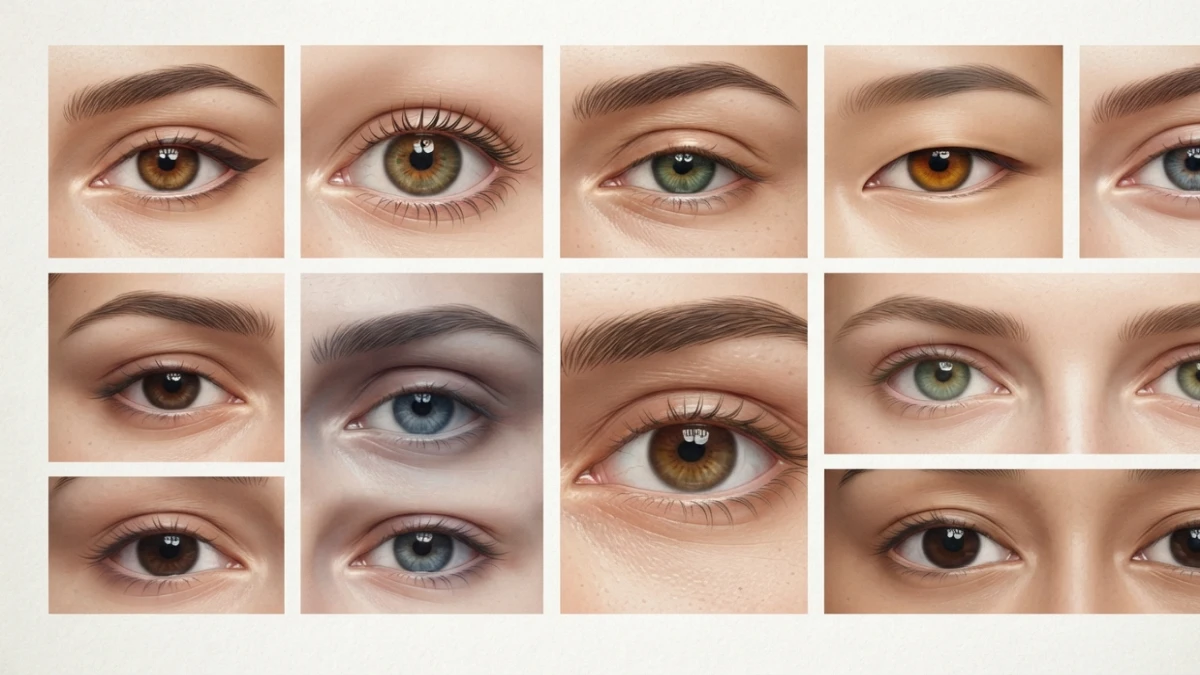
Eyes are often one of the first features we notice about a face and describing their shape can make beauty, character design, photography, makeup, or even portrait writing much more precise.
What Are Eye Shape Names?
Eye shape names describe the visible structure and proportions of the eyes, including the position of the outer and inner corners, the amount of visible eyelid, and whether the eyes appear elongated, rounded, tapered, lifted, or hooded.
Common eye shape names include almond, round, hooded, monolid, upturned, downturned, and deep set. Many people also have a combination of these characteristics rather than fitting perfectly into one category.
Common Eye Shapes at a Glance
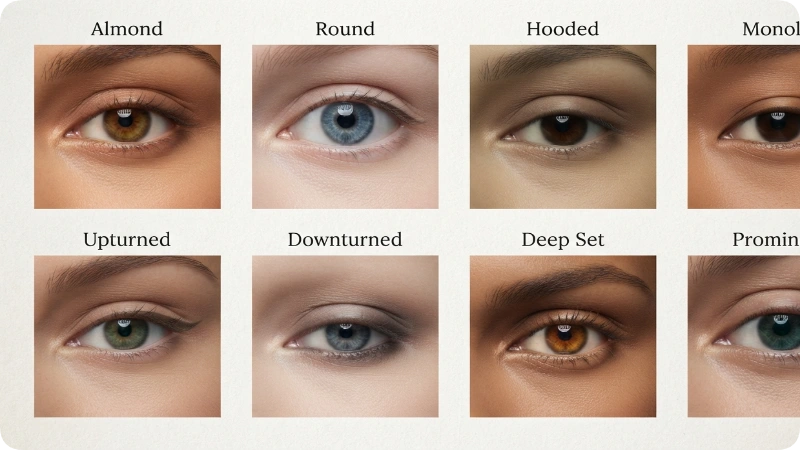
| Eye shape | Key visual feature | Overall impression | Makeup/visual vibe |
| Almond | Tapered corners, elongated opening | Balanced, elegant | Versatile, refined |
| Round | More visible iris and taller opening | Open, youthful | Soft, expressive |
| Hooded | Fold partly covers the eyelid | Sultry, mysterious | Smoky, dramatic |
| Monolid | Minimal or absent visible crease | Sleek, clean | Graphic, modern |
| Upturned | Outer corner sits higher | Lifted, energetic | Cat eye, sharp |
| Downturned | Outer corner sits lower | Soft, gentle | Romantic, doe eyed |
| Deep set | Eyes sit farther back beneath brow | Sculpted, intense | Dramatic, dimensional |
| Protruding | Eyes project more noticeably | Prominent, expressive | Defined, luminous |
| Close set | Eyes sit relatively near each other | Focused, delicate | Inner corner brightening |
| Wide set | Greater distance between eyes | Airy, striking | Balanced, elongated |
These categories can overlap. For example, someone can have almond shaped, hooded, and slightly upturned eyes.
1. Almond Eyes
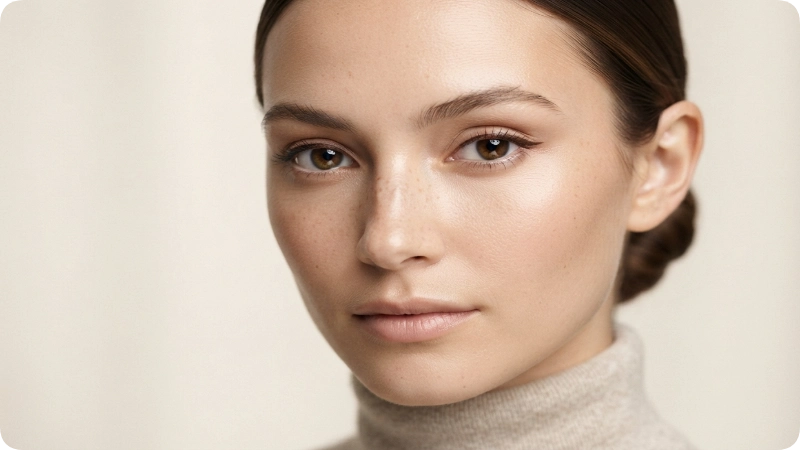
Snippet answer: Almond eyes have an elongated opening with tapered inner and outer corners, often resembling the outline of an almond. The iris typically touches or nearly touches the upper and lower eyelids, creating a balanced, gently elongated appearance.
Almond is one of the most commonly used descriptive terms for eye shape. The defining characteristic isn’t simply that the eye looks narrow; rather, the eye has a tapered shape at both corners.
Typical impression: elegant, balanced, refined, slightly mysterious.
Beauty vocabulary: cat eye, elongated, graceful, symmetrical looking.
Important distinction: Almond describes the shape of the opening. A person can simultaneously have almond shaped and hooded eyes.
2. Round Eyes
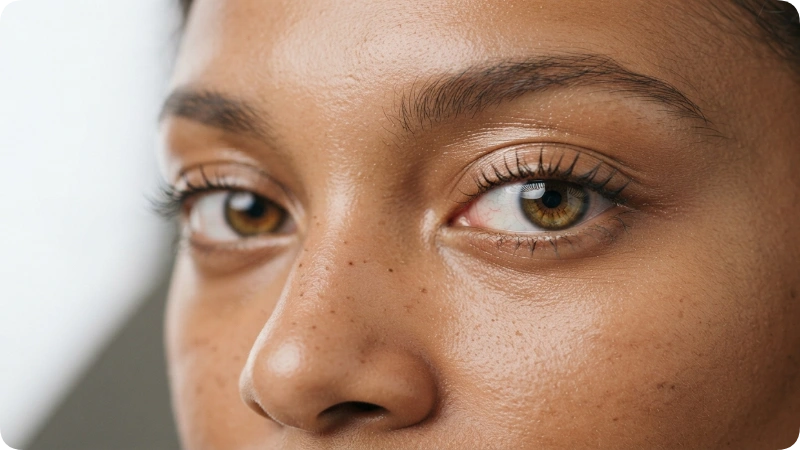
Snippet answer: Round eyes generally appear taller and more open than almond eyes, with a greater amount of visible white around the iris. They often create a bright, expressive, youthful, or doe eyed appearance.
Round eyes are frequently associated with openness and expressiveness in beauty descriptions and character design.
Typical impression: innocent, expressive, bright, youthful.
Aesthetic vocabulary: doe eyed, doll like, wide eyed, soft.
In fiction and illustration, exaggerated round eyes are especially common because they immediately communicate emotion.
3. Hooded Eyes
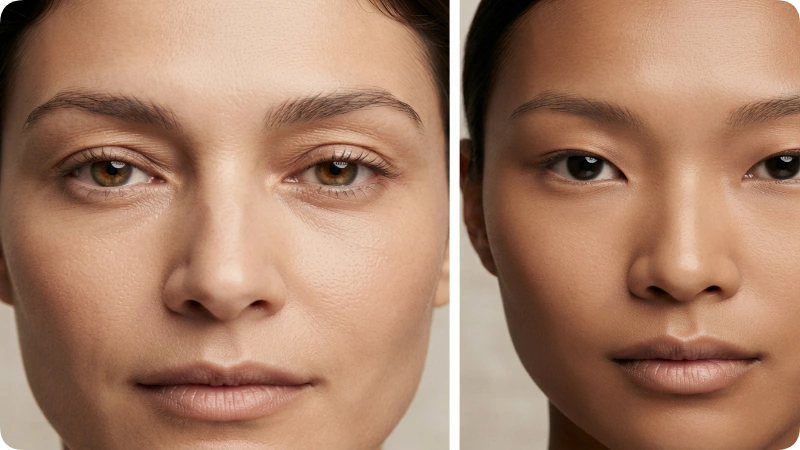
Snippet answer: Hooded eyes have excess skin or a prominent upper eyelid fold that partially covers the mobile eyelid when the eyes are open. Hooding varies considerably from person to person and can occur with many different eye shapes.
Hooded is better understood as an eyelid characteristic than as a completely separate eye shape.
Someone can have:
- hooded almond eyes
- hooded round eyes
- hooded upturned eyes
- hooded downturned eyes
This distinction matters because eye shape terminology often describes several features at once.
Typical impression: sultry, mysterious, sophisticated, deep.
4. Monolid Eyes
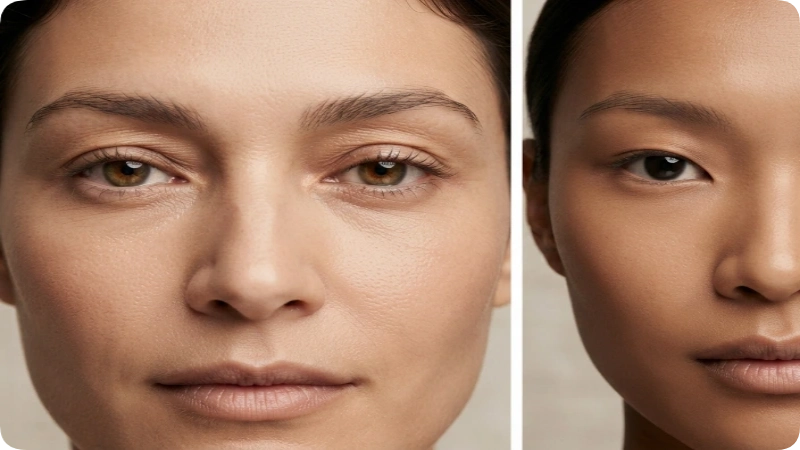
Snippet answer: A monolid is an eyelid structure in which there is little or no visible supratarsal crease separating the eyelid from the area beneath the brow. Monolids are a normal anatomical variation and are particularly common in several East Asian populations.
Monolid should be treated as an anatomical descriptor, not a personality type or beauty ranking.
The appearance can range from very subtle to strongly defined, and monolid eyes can also be elongated, rounded, upturned, or downturned.
Cultural note: Avoid treating monolids as inherently exotic or unusual. They are a natural human variation.
5. Upturned Eyes
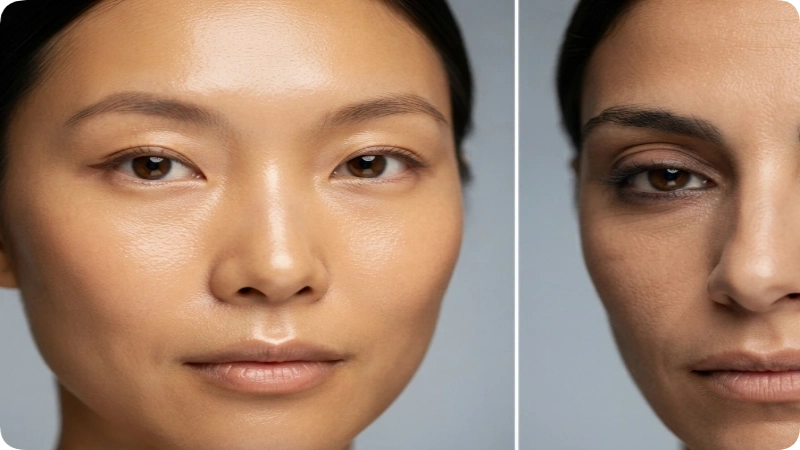
Snippet answer: Upturned eyes have outer corners that sit slightly higher than the inner corners. This creates a naturally lifted appearance and is often associated with a feline, energetic, or elegant visual effect.
Upturned eyes are sometimes described as cat like because of their upward sweep.
Typical impression: confident, lively, sleek, playful.
Aesthetic vocabulary: fox eye, feline, lifted, sharp.
The popular “fox eye” aesthetic is a styling concept rather than a precise anatomical eye shape category.
6. Downturned Eyes
Snippet answer: Downturned eyes have outer corners that sit lower than the inner corners. The resulting angle can create a naturally soft, gentle, or wistful appearance, although facial expression and surrounding features strongly influence how the eyes are perceived.
Downturned eyes are sometimes called puppy eyes in beauty and internet style vocabulary.
That nickname is an aesthetic comparison, not an anatomical classification.
Typical impression: gentle, tender, romantic, approachable.
7. Deep Set Eyes
Snippet answer: Deep set eyes appear farther back beneath the brow ridge, often creating visible shadow around the upper eyelid. This structural characteristic can produce a sculpted, intense, or dramatic appearance.
Deep set describes eye position within the eye socket, rather than the outline of the eye itself.
That means someone can have deep set almond eyes, deep set round eyes, and so on.
Typical impression: intense, mature, sculpted, mysterious.
8. Protruding Eyes
Snippet answer: Protruding or prominent eyes project farther forward from the eye socket and may show more of the eyelid or surrounding eye area. Like deep set eyes, this term describes eye placement and projection rather than a simple outline.
The term prominent eyes is often preferable in everyday beauty writing because it can sound more neutral and descriptive.
Typical impression: noticeable, expressive, luminous.
9. Close Set Eyes
Snippet answer: Close set eyes are positioned relatively near one another, generally with less space between the eyes compared with their individual width. This is a proportional characteristic rather than a distinct eyelid or eye outline shape.
Close set eyes can occur alongside many other shapes.
For example:
close set + almond + hooded
is more informative than simply saying “almond eyes.”
10. Wide Set Eyes
Snippet answer: Wide set eyes have comparatively more space between the eyes. This can create an airy, open, distinctive facial balance and is best understood as a proportional characteristic rather than a standalone eye shape.
Like close set eyes, wide set eyes can coexist with round, almond, hooded, or other eye characteristics.
Eye Shape Categories That Are Often Confused
One reason eye shape terminology becomes confusing is that different names describe different dimensions of the eye.
| Category | Examples | What it describes |
| Outline | Almond, round | Shape of the eye opening |
| Corner direction | Upturned, downturned | Angle between corners |
| Eyelid structure | Hooded, monolid | Visible crease/fold |
| Socket position | Deep set, prominent | How far the eye sits in the orbit |
| Facial spacing | Close set, wide set | Distance between the eyes |
This is why two people can both have “almond eyes” while looking completely different
Eye Shape Names for Beauty and Makeup
For makeup or beauty content, the most useful approach is to identify multiple characteristics, not force the eye into one label.
For example:
Almond + slightly upturned + hooded
is much more descriptive than simply:
Almond eyes
A simple identification method
Look straight ahead in a relaxed expression and consider:
- Are the inner and outer corners tapered?
→ Possibly almond. - Does the eye look especially tall/open?
→ Possibly round. - Does the outer corner sit higher?
→ Upturned. - Does the outer corner sit lower?
→ Downturned. - Is much of the mobile eyelid hidden by the upper fold?
→ Hooded. - Is there little or no visible eyelid crease?
→ Monolid. - Do the eyes appear farther back beneath the brow?
→ Deep set. - Is there relatively large space between the eyes?
→ Wide set. - Are the eyes relatively close together?
→ Close set.
No single test should be treated as a definitive diagnosis; facial anatomy exists on a spectrum.
Eye Shapes and Their Aesthetic Vibes
Eye shape descriptions often carry an emotional or artistic association, but these associations are aesthetic interpretations rather than scientific personality traits.
| Eye shape | Common aesthetic association |
| Almond | Elegant, polished, mysterious |
| Round | Open, innocent, expressive |
| Hooded | Sultry, sophisticated, enigmatic |
| Monolid | Sleek, modern, graphic |
| Upturned | Feline, energetic, confident |
| Downturned | Soft, romantic, gentle |
| Deep set | Intense, dramatic, sculpted |
| Prominent | Expressive, striking, luminous |
| Wide set | Airy, distinctive, serene |
| Close set | Focused, delicate, concentrated |
These impressions can also change dramatically depending on eyebrows, lashes, facial proportions, makeup, lighting, and expression.
Eye Shape Names in Character Design and Fiction
Eye shape becomes especially useful when creating characters.
Writers and artists can use eye descriptions to reinforce a character’s visual identity without claiming that anatomy determines personality.
For elegant characters
Consider:
- almond eyes
- slightly upturned eyes
- deep set eyes
Youthful characters
- round eyes
- large looking eyes
- wide set eyes
Mysterious characters
- hooded eyes
- deep set eyes
- elongated almond eyes
Sharp or intimidating designs
- narrow almond eyes
- strongly upturned eyes
- deep set eyes
For gentle characters
- round eyes
- downturned eyes
- softly hooded eyes
These are visual storytelling conventions, not biological rules.
The Most Beautiful Eye Shape?
There is no objectively “best” eye shape. Beauty standards change across cultures, historical periods, photography trends, makeup movements, and individual preferences.
Almond eyes may be frequently praised for their versatility, while round eyes can be celebrated for their openness and hooded eyes for their depth. None is inherently more attractive.
A more useful question is:
Which eye shape creates the visual impression you want?
Eye Shape Names: Quick Comparison
| If you want… | Eye shape often associated with that look |
| Elegant | Almond |
| Youthful | Round |
| Mysterious | Hooded |
| Sleek | Monolid |
| Feline | Upturned |
| Gentle | Downturned |
| Intense | Deep set |
| Striking | Prominent |
| Airy | Wide set |
| Focused | Close set |
These are aesthetic associations, not fixed personality meanings.
FAQS
What are the 7 main eye shapes?
A commonly used list includes almond, round, hooded, monolid, upturned, downturned, and deep set. However, these aren’t seven mutually exclusive categories. Some describe outline, some eyelid structure, and some eye position.
Are almond eyes the most common eye shape?
“Most common” is difficult to establish globally because eye shape has no universally standardized classification system and populations vary. It is safer to describe almond eyes as a widely recognized eye shape category rather than claim they are universally the most common.
Can you have two eye shapes?
Yes. In fact, describing multiple characteristics is often more accurate. Someone may have hooded, almond shaped, slightly upturned eyes.
What eye shape looks the most youthful?
Rounder, more open looking eyes are commonly associated with a youthful or doe eyed aesthetic. However, perceived age depends on many facial characteristics not eye shape alone.
What eye shape is considered elegant?
Almond eyes are frequently associated with an elegant and balanced aesthetic, particularly because their elongated, tapered outline works well with many makeup styles. “Elegant,” however, is a subjective beauty judgment.
What is the difference between almond and round eyes?
The key difference is the height to width appearance and corner shape. Almond eyes tend to have a more elongated, tapered opening, while round eyes tend to appear taller and more open.
Are hooded eyes and deep set eyes the same?
No. Hooded eyes concern the eyelid fold, while deep set eyes concern how far the eyes sit within the eye socket. A person can have both.
What are fox eyes?
“Fox eyes” is primarily a beauty and styling term, associated with an elongated, lifted outer corner and a feline appearance. It isn’t a standardized anatomical eye shape classification.
Final Thoughts
Eye shape names are most useful when they help you describe rather than judge.
The most accurate description may be a combination: almond and slightly upturned, round and hooded, or monolid and wide set. Once you understand that different terms describe different aspects of facial anatomy, the vocabulary becomes much easier to use.
And that’s the real beauty of eye shape terminology: it gives you a more precise language for noticing the subtle details that make every face distinctive.

Amara uncovers the hidden history, origins, and meanings behind names. She curates Namestylo’s historical, cultural, and baby naming guides to ensure every suggestion carries deep significance. In her free time, she devours historical fiction and mythology.