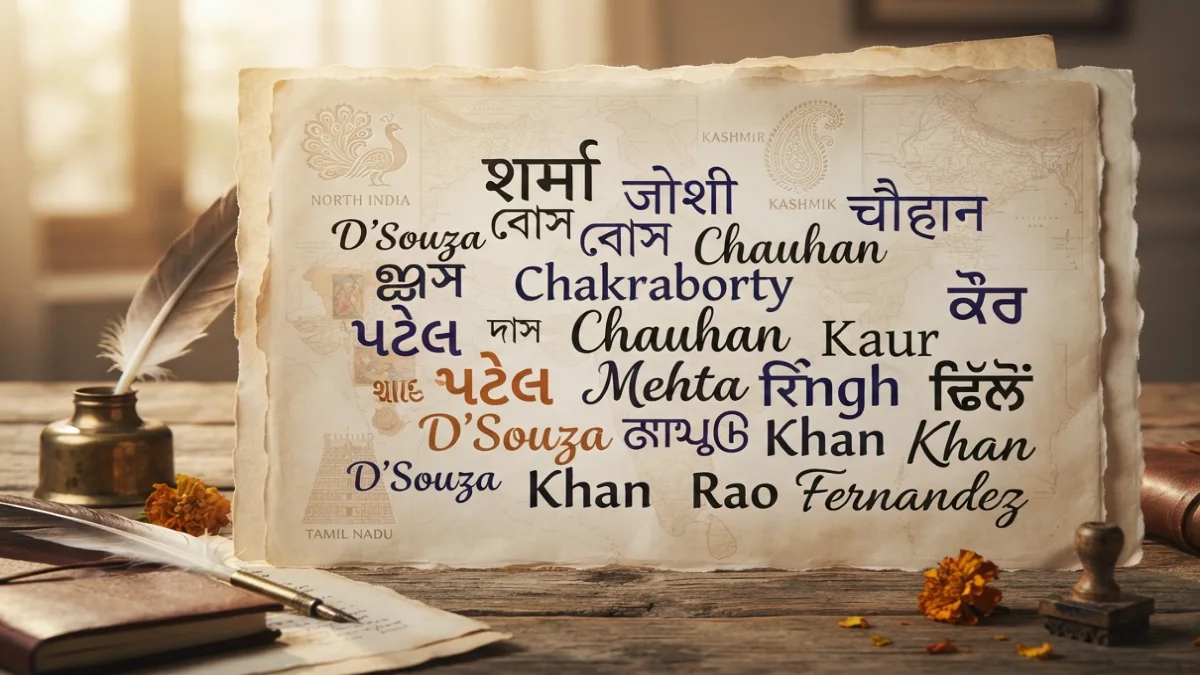
India’s last names are rarely just labels at the end of a full name. They can preserve a place, occupation, title, language, community tradition, religious history, or a family’s way of identifying itself.
That is what makes Indian last names so fascinating and also why a simple alphabetical list rarely tells the whole story.
A surname such as Patel can evoke Gujarat and the historical role of a village headman; Iyer points toward a specific Tamil Brahmin community; Singh carries a major Sikh history while also appearing far beyond Sikh families; and in parts of South India, a “last name” may actually be a father’s given name or an initial rather than a hereditary surname.
If you are choosing a surname for a character, researching family heritage, building a fictional Indian family, or simply looking for a name that feels distinctly Indian, the best place to begin is with region, language, cultural context, and naming tradition not just meaning.
Indian last names at a glance
Indian surnames come from many sources, including occupations, village names, titles, clans, religious traditions, and patronymic naming systems. There is no single Indian surname pattern. Northern, western, eastern, and southern regions can have substantially different conventions, and the same surname may have different associations in different communities.
| Surname | Broad regional association | Traditional connection | Overall feel |
| Sharma | North/Central India | Traditional Brahmin surname/title | Classic, scholarly |
| Patel | Gujarat | Village leadership/title; later hereditary surname | Strong, established |
| Singh | North India/Punjab; widespread | Sikh naming tradition and wider historical use | Powerful, dignified |
| Gupta | North/Central India | Historical community and occupational associations | Polished, classic |
| Mehta | Western/Northwestern India | Administrative/clerical title | Refined, professional |
| Desai | Gujarat/Maharashtra | Administrative/revenue title | Elegant, traditional |
| Iyer | Tamil Nadu | Tamil Brahmin community name | Scholarly, distinctly South Indian |
| Nair | Kerala | Historic community/title | Strong, regional |
| Reddy | Andhra Pradesh/Telangana | Historic title/community surname | Grounded, authoritative |
| Banerjee | Bengal | Bengali Brahmin surname | Literary, sophisticated |
| Mukherjee | Bengal | Bengali Brahmin surname | Classic, intellectual |
| Bose | Bengal | Bengali surname | Compact, cultured |
| Kapoor | North India | Punjabi/Khatri associated surname | Stylish, familiar |
| Malhotra | Punjab/North India | Punjabi Khatri surname | Urban, polished |
| Joshi | North/West India | Traditionally associated with astrologers/scholars | Learned, approachable |
| Mishra | North India | Traditional Brahmin surname | Sanskritic, classic |
| Trivedi | North/West India | Traditional scholarly/Brahmin surname | Learned, distinctive |
| Nair | Kerala | Historic Kerala community name | Strong, regional |
| Menon | Kerala | Historic honorific/title | Sophisticated, understated |
Regional and community associations are historical patterns, not rules for determining an individual’s identity.
Why Indian surnames are so diverse
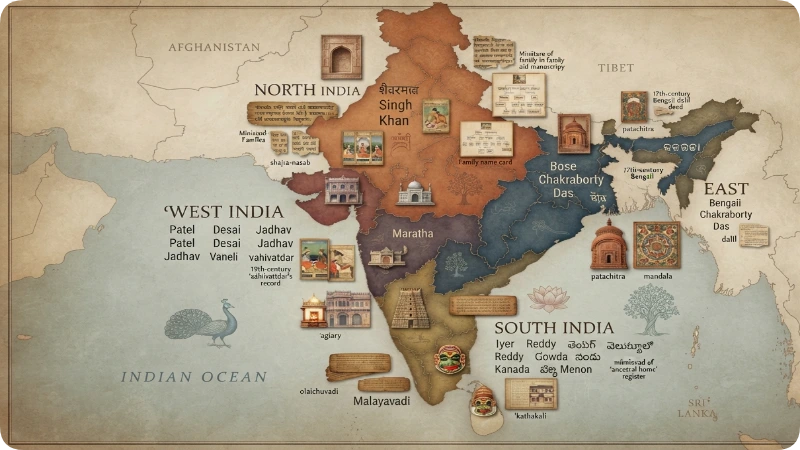
India does not have one universal surname system.
A surname can be patronymic, occupational, geographic, titular, clan based, religious, or community associated. In some families it is hereditary; in others, what looks like a surname may actually represent a parent, ancestral village, or house name.
This matters when choosing a name. A surname can sound beautifully Indian while being culturally mismatched with the character, family, or setting you have in mind.
North Indian last names
Many North Indian naming patterns resemble the familiar given name plus family name structure. Surnames such as Sharma, Singh, Gupta, Mishra, Verma, Yadav, Kapoor, Malhotra, and Khanna are widely encountered, although their histories and community associations differ.
For example, Sharma has long standing Brahmin associations, while Singh has an especially important Sikh history. The Shiromani Gurdwara Parbandhak Committee records that Guru Gobind Singh gave the surname Singh to the first Khalsa initiates in 1699; Singh means “lion.”
Western Indian last names
Western India gives us surnames such as Patel, Patil, Desai, Mehta, Shah, Joshi, Kulkarni, and Deshmukh.
Many have roots in historical occupations or administrative titles. Patel, for instance, developed from a title associated with village headmen and land administration in Gujarat and later became a hereditary surname.
Names ending in kar are also strongly associated with Maharashtra and surrounding western regions in many contexts, often reflecting a place of origin.
Bengali and eastern Indian last names
Bengal has a particularly recognizable surname aesthetic.
Names such as:
- Banerjee
- Chatterjee
- Mukherjee
- Bhattacharya
- Bose
- Ghosh
- Sen
- Das
- Roy
can immediately give a fictional character or naming combination a Bengali cultural texture.
Several prominent Bengali surnames have historical associations with Brahmin communities, while others cross community boundaries. Mukherjee, for example, is associated with Bengal and has a traditional Brahmin history.
South Indian last names
South Indian naming traditions require extra care because a conventional “surname” is not always present.
In parts of Tamil Nadu, Karnataka, Kerala, and Andhra/Telangana, families may traditionally use patronymics, initials, ancestral place names, house names, titles, or community names. A father’s given name can therefore appear where a Western reader expects a hereditary surname.
This is one reason a name such as R. Karthik should not automatically be interpreted using Western assumptions about first, middle, and last names.
30 Indian last names worth exploring
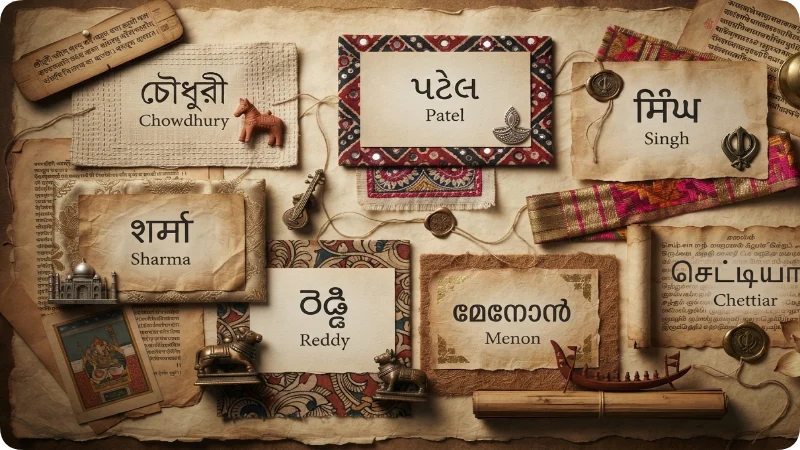
Rather than treating every surname as interchangeable, this list groups names by the impression and cultural landscape they commonly evoke.
Classic and widely recognizable
Sharma A classic North Indian surname with traditional Brahmin associations. It feels scholarly, established, and unmistakably familiar.
Singh Literally associated with the lion and deeply connected with Sikh history. Its emotional energy is strong, proud, and dignified.
Gupta An old and widely recognized surname with historical associations across North and Central India. It has a polished, traditional sound.
Kumar Commonly used as a given or middle name as well as a surname, making it more flexible and less regionally specific than many family names.
Verma A familiar North Indian surname with a smooth, formal sound.
Joshi Traditionally associated in several regions with scholarly or astrological roles; compact and approachable.
Elegant and refined
Mehta A surname/title with historical administrative associations. Its short, clean sound works especially well in modern settings.
Desai Strongly associated with western India and historically linked with administrative roles. It has an understated, sophisticated rhythm.
Shah Short, memorable, and especially familiar in Gujarati contexts, while also appearing in other communities.
Kapoor A recognizable North Indian/Punjabi surname with a stylish, cinematic quality in contemporary popular culture.
Malhotra Long, polished, and distinctly Punjabi/North Indian in feel.
Khanna Smooth and urbane, with a compact two syllable rhythm.
Bengali and literary feeling
Banerjee Strong Bengali identity and a distinctly traditional, intellectual sound.
Chatterjee Another highly recognizable Bengali surname, with a formal and literary impression.
Mukherjee Traditional, elegant, and strongly associated with Bengali heritage.
Bhattacharya Longer and more classical in sound, with traditional scholarly associations.
Bose Exceptionally compact. It feels crisp, cultured, and memorable.
Ghosh Short and unmistakably Bengali in many naming contexts.
Sen Minimalist and elegant, making it particularly easy to pair with modern given names.
South Indian
Iyer A Tamil Brahmin community surname associated with the Smarta tradition. It has a strongly regional and cultural identity rather than being simply a generic “Indian” surname.
Iyengar Associated with Tamil Brahmin Vaishnavite traditions and distinct from Iyer. The distinction matters when cultural specificity is important.
Nair A historic Kerala community name with a strong regional identity.
Menon A Kerala associated surname/title with an elegant, restrained sound.
Reddy Strongly associated with Andhra Pradesh and Telangana and historically connected with a title/community tradition.
Naidu Found especially in Telugu speaking regions and parts of Tamil Nadu, with historical roots in nayaka, “leader.”
Rao A compact, regal sounding surname/title used across several parts of India.
Pillai Associated particularly with Tamil Nadu and Kerala and historically used as an honorific/title.
Indian surnames by aesthetic
Sometimes you are not searching for genealogy. You simply want a surname with a particular sound, atmosphere, or character energy.
| If you want… | Consider | Why it works |
| Scholarly | Sharma, Joshi, Mishra, Trivedi | Learned, traditional resonance |
| Regal | Singh, Rao, Deshmukh | Strong, authoritative sound |
| Soft/elegant | Sen, Bose, Mehta, Nair | Clean syllables and restrained rhythm |
| Luxurious | Malhotra, Kapoor, Mehta | Polished, urban impression |
| Literary | Banerjee, Mukherjee, Bose, Sen | Strong Bengali cultural associations |
| Traditional | Sharma, Gupta, Mishra, Iyer | Long established naming traditions |
| Modern | Mehta, Shah, Sen, Bose | Short, clean, globally usable |
| Strong | Singh, Reddy, Yadav, Rao | Firm consonants and commanding rhythm |
| Distinctly South Indian | Iyer, Nair, Menon, Reddy, Naidu | Strong regional identity |
| Distinctly Bengali | Banerjee, Chatterjee, Mukherjee, Bose, Ghosh | Recognizable Bengali naming texture |
| Distinctly Gujarati | Patel, Shah, Desai, Mehta | Strong western Indian associations |
These are aesthetic impressions, not objective properties of the people who carry these surnames.
Indian last names with powerful energy
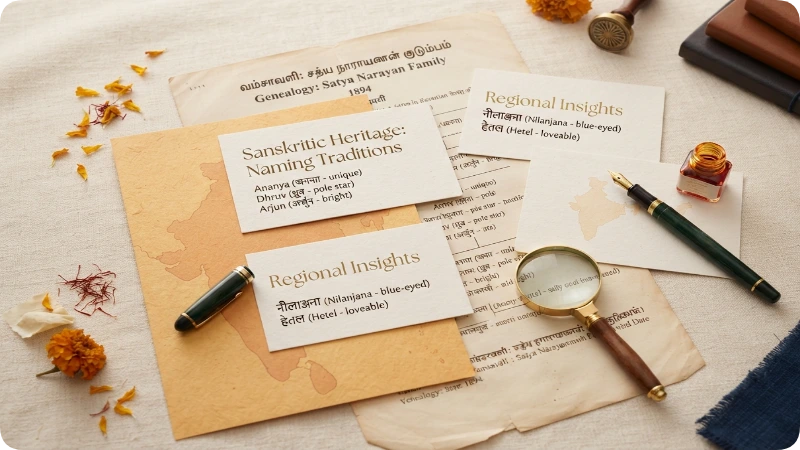
Some surnames feel almost architectural: compact, grounded, and difficult to forget.
Singh
Meaning: Lion
Cultural relevance: Especially important in Sikh naming tradition
Gender: Traditionally used by Sikh men; also used more broadly by people from varied communities
Pronunciation: Commonly pronounced with a short “i” sound and final nasal consonant
Vibe: Courageous, dignified, commanding
Aesthetic: Warrior, classic, authoritative
Modern feel: Timeless
The word’s association with the lion gives Singh a naturally powerful emotional image. But its significance is deeper than a generic “strong surname”: its role in Khalsa identity dates to Guru Gobind Singh’s creation of the Khalsa in 1699.
Rao
Meaning: Historically a title associated with a ruler/chief in several Indian contexts
Regions: Especially associated with parts of western and southern India
Vibe: Regal, concise, authoritative
Aesthetic: Minimalist royalty
Modern feel: Classic but highly usable
Reddy
Region: Andhra Pradesh and Telangana
Vibe: Grounded, established, confident
Aesthetic: Regional, traditional, substantial
Reddy is particularly useful when a character needs a surname that immediately feels connected to Telugu speaking South India.
Indian last names with an elegant or literary feel
Sen
Sen has a wonderfully economical shape. One syllable, strong consonants, and an unmistakable South Asian literary association.
It pairs easily with short or elaborate given names:
- Arjun Sen
- Mira Sen
- Anaya Sen
- Dev Sen
The result feels contemporary without losing cultural character.
Bose
Bose is similarly compact but has a more distinctive visual identity.
It works especially well for:
- fictional characters
- authors and artists
- contemporary professional names
- sophisticated sibling sets
Its brevity also makes it highly usable internationally.
Banerjee
Banerjee creates a much more traditional Bengali impression. Compared with Sen or Bose, it feels longer, more formal, and more heritage rich.
Best for: characters or families where Bengali cultural specificity matters more than minimalist styling.
Indian last names that feel modern
Modern does not necessarily mean newly invented.
Often, the most contemporary looking surname is simply an established name with clean phonetics and strong usability across borders.
Good examples include:
- Sen
- Bose
- Shah
- Mehta
- Rao
- Nair
- Kapoor
- Patel
Their appeal comes partly from simplicity: they are relatively easy to pronounce, spell, remember, and combine with many given names.
For a global facing character, brand, pen name, or fictional family, this can matter as much as etymology.
Indian surnames and religion: an important distinction
Indian surnames can carry religious significance, but they should never be treated as perfect identity detectors.
Singh and Kaur are especially important examples in Sikh naming. The Khalsa tradition established by Guru Gobind Singh in 1699 used Singh among the first initiated Sikhs, with the name connected to the meaning “lion.”
At the same time, Singh is now used by people across different communities, regions, and historical traditions.
Likewise, surnames such as Das, Roy, Khan, Joseph, George, Shah, and others can occur across multiple communities or historical contexts.
A surname can provide cultural clues; it should not be used as definitive proof of someone’s religion, caste, or identity.
Can you tell caste from an Indian surname?
Not reliably.
Some Indian surnames have strong historical associations with particular communities. But surnames can be shared across communities, adopted by different families, changed over time, or used differently from one region to another. Surname ≠ guaranteed caste identity.
This is especially important for modern naming research. A surname can tell you something about historical usage without telling you everything about the individual carrying it.
For naming or character building, it is better to think in terms of cultural fit and historical plausibility rather than trying to infer someone’s caste from a surname.
Lucky numbers, colors and gemstones: what can actually be verified?
Searches for Indian names frequently attach attributes such as lucky numbers, colors, gemstones, days, or zodiac signs.
These can be fun as traditional numerology or naming site interpretations, but they are not objective properties of a surname.
For that reason, they should not be presented as factual etymology.
| Attribute | How to interpret it responsibly |
| Lucky number | Numerology tradition, not a verified property |
| Lucky color | Cultural/numerological association if a tradition specifies one |
| Lucky stone | Traditional belief rather than scientific fact |
| Lucky day | Astrological/numerological tradition |
| Zodiac | Usually belongs to a person’s birth details, not a surname |
| Numerology | Interpretive system, not established science |
| Personality | Editorial/aesthetic impression, not a prediction |
For Indian last names, region, language, family history, and naming tradition are much more meaningful evidence than assigning a gemstone or number to every surname.
How to choose an Indian surname for a character
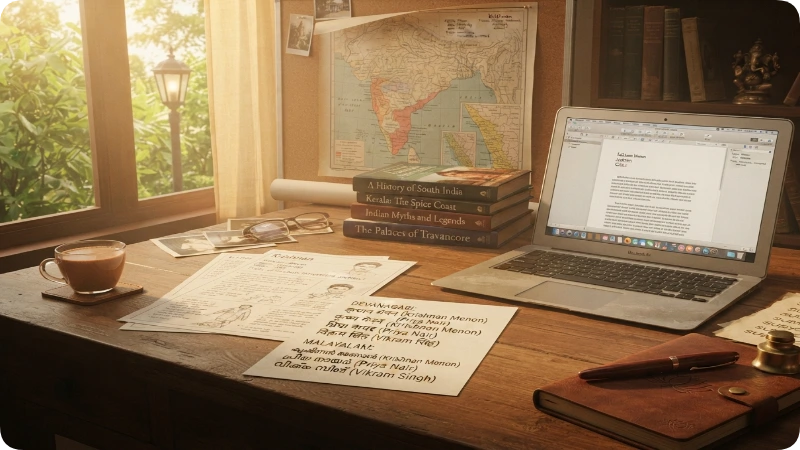
A believable name is more than a pretty combination.
Start with geography
Ask where the character or family comes from.
A Bengali character might plausibly have a surname such as Sen, Bose, Ghosh, Banerjee, Mukherjee, or Chatterjee.
A Gujarati character might plausibly use Patel, Shah, Mehta, or Desai.
A Tamil character could have a naming structure involving Iyer, Iyengar, or a patronymic/initial system, depending on family background.
A Kerala character might have Nair, Menon, Pillai, or another regional family/community name.
Then check naming structure
This is where many otherwise convincing fictional names become culturally awkward.
Don’t automatically assume:
Given name + middle name + hereditary surname
is the only Indian pattern.
In some South Indian traditions, the apparent “surname” can represent a father’s name, ancestral village, house name, or another naming element.
Finally, listen to the whole name
Say the full combination aloud.
A good surname should support the given name rather than compete with it.
Long first name + long surname can feel grand and formal.
Short first name + short surname can feel modern and editorial.
Soft first name + strong surname creates contrast.
For example:
| Combination | Impression |
| Mira Sen | Minimal, literary |
| Aarav Mehta | Contemporary, polished |
| Arjun Singh | Strong, classic |
| Ananya Banerjee | Traditional, elegant |
| Riya Kapoor | Urban, stylish |
| Dev Rao | Compact, commanding |
| Kavya Nair | Soft, refined, regional |
| Aditya Sharma | Familiar, classic |
These are aesthetic judgments about the sound of the combination, not statements about the people or communities represented.
Best Indian surnames for sibling names
Sibling compatibility is mostly about rhythm and consistency, not making every name rhyme.
Soft modern sibling set
- Mira Sen
- Tara Sen
- Aria Sen
The short surname gives the given names room to carry the personality.
Traditional North Indian set
- Arjun Sharma
- Kavya Sharma
- Rohan Sharma
The surname anchors three different first name styles without sounding mismatched.
Bengali literary set
- Anika Bose
- Rohan Bose
- Ishaan Bose
The compact surname keeps longer first names from becoming cumbersome.
South Indian regional set
- Karthik Nair
- Meera Nair
- Devika Nair
The combination has a clear regional identity while remaining easy to pronounce internationally.
Indian surname combinations by personality
| Character energy | Surname ideas | Why |
| Quiet intellectual | Sen, Bose, Joshi | Restrained, cultured sound |
| Ambitious professional | Mehta, Shah, Kapoor | Crisp and polished |
| Traditional scholar | Sharma, Mishra, Trivedi | Classical associations |
| Warrior/hero | Singh, Rao, Yadav | Strong phonetic energy |
| Mysterious artist | Bose, Sen, Nair | Short, atmospheric |
| Royal fantasy | Rao, Singh, Deshmukh | Commanding resonance |
| Romantic heroine | Sen, Nair, Kapoor | Soft to polished contrast |
| Historical character | Mukherjee, Banerjee, Iyer | Strong cultural specificity |
| Modern urban character | Mehta, Shah, Sen, Kapoor | Contemporary usability |
A deeper way to think about Indian surnames
The most useful question is not:
“What does this surname mean?”
It is:
“What story does this surname place the person inside?”
A surname can quietly suggest:
- a region
- a language
- an ancestral occupation
- a community tradition
- a historical title
- a migration story
- a religious tradition
- a relationship with a particular place
- or a modern family choice to simplify or change an older naming practice
That is why Patel, Singh, Iyer, Banerjee, Nair, Bose, and Mehta should not be treated as interchangeable decorative labels.
Their sounds matter but their cultural contexts matter more.
Frequently asked questions
What are some common Indian last names?
Some widely recognized Indian surnames include Singh, Sharma, Patel, Gupta, Kumar, Verma, Mehta, Shah, Kapoor, Mishra, Joshi, Iyer, Nair, Reddy, Rao, Banerjee, Mukherjee, Bose, and Desai. Their prevalence varies substantially by region, community, and naming tradition, so there is no single universally authoritative national ranking.
What is the most common Indian surname?
There is no single reliable, comprehensive national ranking that establishes one surname as India’s definitive “most common.” India has highly diverse regional naming systems, and some frequently used names function as given names, middle names, titles, or patronymics as well as surnames.
What does Patel mean?
Patel is historically connected with the role of a village headman and land administration, particularly in Gujarat. The title subsequently became a hereditary surname and is strongly associated with Gujarat and Patidar communities.
What does Singh mean?
Singh derives from Sanskrit siṃha, meaning “lion.” It has a particularly important place in Sikh history because Guru Gobind Singh introduced Singh into the Khalsa naming tradition in 1699.
Is Singh only a Sikh surname?
No. Singh has a particularly important Sikh association, but it is also used by people from other communities and historical traditions. A surname alone should not be treated as definitive evidence of religious identity.
Why do some South Indians not have a surname?
In several South Indian naming traditions, hereditary family surnames are not always used in the same way as in North India. Patronymics, initials, ancestral place names, house names, titles, and other naming elements may be used instead.
Is Iyer the same as Iyengar?
No. Iyer and Iyengar refer to distinct Tamil Brahmin traditions. Iyers are associated with the Smarta tradition, while Iyengars are associated with Sri Vaishnavism.
Can an Indian surname tell you someone’s caste?
Not with certainty. Some surnames have historical community or caste associations, but surnames can cross community boundaries and change over time. Treating a surname as definitive evidence of an individual’s caste is unreliable.
Which Indian surnames sound elegant?
For a clean, refined sound, consider Sen, Bose, Mehta, Nair, Shah, Desai, Kapoor, or Banerjee. “Elegant” here describes the sound and aesthetic impression of the surname, not a characteristic of the people who use it.
Which Indian surnames work well internationally?
Short surnames such as Sen, Bose, Shah, Rao, Mehta, Nair, and Patel are generally easy to spell and remember in English speaking environments. But cultural appropriateness should come before international convenience.
Final thoughts
The beauty of Indian last names lies in their variety.
like old titles. preserve geography. Some carry religious history. Others reflect occupation, scholarship, clan, community, or a parent’s name. And some have traveled so widely that their original associations have become only one part of their modern identity.
If you are choosing one for a character, baby name combination, fictional family, pen name, or naming project, start with cultural fit, then consider meaning, pronunciation, rhythm, emotional tone, and usability.
The strongest surname is rarely the one that simply sounds impressive.
It is the one that makes the whole name feel believable, memorable, and alive.

Amara uncovers the hidden history, origins, and meanings behind names. She curates Namestylo’s historical, cultural, and baby naming guides to ensure every suggestion carries deep significance. In her free time, she devours historical fiction and mythology.