Indian last names can feel like tiny pieces of history. A surname may point toward a region, an old occupation, a title, a community, a place of origin, or a family tradition and sometimes its modern use is broader than its historical roots.
This guide explores popular Indian last names not simply as a ranking, but as names with different personalities: some feel scholarly, some regal, some warm and familiar, and others distinctly regional. Because India has no single nationwide surname tradition, the most useful way to understand these names is through origin, cultural context, sound, and modern usability.
Featured snippet: Popular Indian last names include Sharma, Singh, Patel, Gupta, Kumar, Yadav, Reddy, Nair, Iyer, Mehta, Desai, Banerjee, Chatterjee, Verma, Mishra, Joshi, Rao, Shah, Agarwal, and Menon. Their histories can reflect occupation, place, ancestry, title, language, religion, or community.
What Makes an Indian Last Name “Popular”?
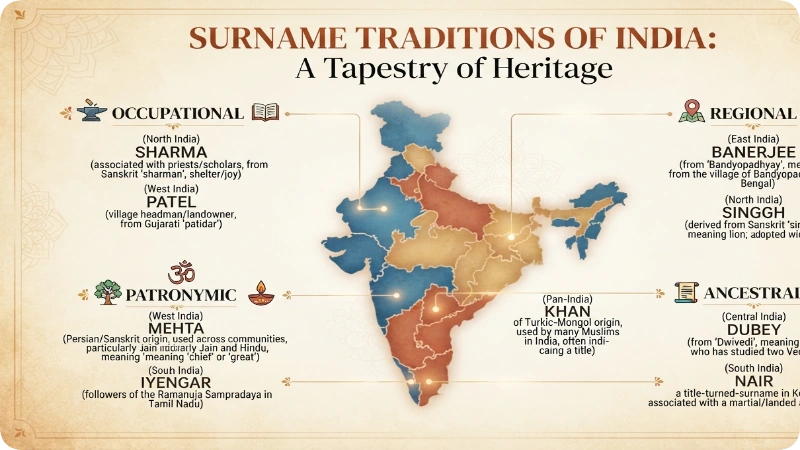
There is no authoritative, current national ranking of Indian surnames. That matters because India has enormous linguistic and regional diversity, and naming conventions differ substantially between communities.
Government naming standards themselves recognize that a person’s full name may contain a given name, surname, patronymic, metronymic, village name, generational identifier, or other culturally meaningful element. In other words, “last name” does not always mean the same thing across India.
For this article, popular means widely recognized, historically established, regionally important, or frequently encountered in India and the Indian diaspora not a claim that these surnames are ranked from #1 onward.
A useful way to think about Indian surnames
| Naming pattern | What it may reflect | Examples |
| Occupational | An ancestral profession or office | Patel, Desai, Kulkarni |
| Patronymic | A father’s or ancestor’s name | Many South Indian naming systems |
| Regional | Place, village, or geographic connection | Nagarkar, Mumbaikar |
| Community-linked | Historical community identity | Iyer, Nair, Agarwal |
| Honorific/title | An old status or administrative title | Rao, Rai, Patel |
| Religious | Faith or devotional identity | Singh, Das, Jain |
| Clan/ancestry | Lineage or ancestral tradition | Yadav, Chauhan |
| Linguistic | A surname shaped by a regional language | Banerjee, Chatterjee |
Indian surnames can therefore be much more than hereditary family labels.
25 Popular Indian Last Names to Know

Here is a practical shortlist for readers researching a family name, creating a character, choosing a surname for a fictional family, or looking for an Indian surname that sounds natural with a first name.
| Last name | Broad association / origin | Meaning or historical sense | Overall vibe |
| Sharma | Sanskrit; widely used across North & other regions | Joy, comfort, shelter | Scholarly, polished |
| Singh | Sikh and North Indian usage; also used by other communities | Lion | Strong, heroic |
| Patel | Gujarat | Village headman / administrative title | Established, confident |
| Gupta | Sanskrit; North & East India | Protector, guardian | Classic, intelligent |
| Kumar | Widely used in India | Prince / young man | Familiar, versatile |
| Yadav | North India and beyond | Associated with Yadu/Yadava tradition | Traditional, grounded |
| Reddy | Telugu-speaking regions | Historically associated with regional leadership/landholding | Strong, regional |
| Iyer | Tamil Nadu | Tamil Brahmin community surname | Refined, scholarly |
| Nair | Kerala | Historically a Kerala community name | Distinctive, elegant |
| Mehta | Gujarat, Rajasthan and elsewhere | Historically a title associated with administration/accounting | Sophisticated |
| Desai | Gujarat, Maharashtra | Historic administrative/revenue title | Distinguished |
| Rao | South and western India; multiple traditions | Historically connected with a royal/title form | Regal, concise |
| Shah | Persian-origin surname/title used in India | King | Luxurious, sleek |
| Joshi | North & western India | Traditionally associated with astrologers/scholars | Intellectual |
| Mishra | North India | Traditional Brahmin surname | Classic, formal |
| Verma | North India | Historically a title/name associated with protection or armor | Strong, polished |
| Agarwal | North India; especially merchant traditions | Associated with Agroha/Agarwal tradition | Businesslike, established |
| Banerjee | Bengal | Anglicized form of Bandyopadhyay | Literary, cultured |
| Chatterjee | Bengal | Anglicized form of Chattopadhyay | Sophisticated, Bengali |
| Bose | Bengal | Bengali surname | Artistic, intellectual |
| Menon | Kerala | Historic Kerala title/community surname | Elegant, understated |
| Pillai | Tamil Nadu/Kerala | Historic title/community surname | Traditional, warm |
| Khan | Indian Muslim usage; Turkic origin | Ruler/chief title | Powerful, international |
| Das | Bengal, Odisha, Assam and elsewhere | Servant/devotee | Devotional, gentle |
| Jain | Jain communities across India | Connected to Jain religious identity | Minimal, distinctive |
The meanings above should be read as etymological or historical descriptions, not personality predictions. Sources such as Behind the Name document forms including Sharma, Singh, Patel, Rai, Rao and Shah, while regional references show how occupational and community titles became surnames in different parts of India.
The Most Recognizable Indian Surnames
Sharma
Sharma is one of the most recognizable Indian surnames and has strong Sanskrit roots. It is traditionally associated with Brahmin communities and is widely encountered across several Indian linguistic regions.
Its Sanskrit etymology is connected with ideas such as joy, comfort and shelter.
Naming personality: Sharma feels educated, established and unmistakably South Asian without sounding overly ornate.
- Pronunciation: SHAR-ma
- Cultural relevance: Traditionally Hindu/Brahmin
- Gender: Unisex surname
- Aesthetic: Classic, scholarly
- Modern feel: Familiar rather than rare
- Nickname potential: Usually unnecessary
- Best with: Aarav Sharma, Riya Sharma, Arjun Sharma
- Social impression: Professional, conventional, recognizable
Important distinction: “Scholarly” is a modern impression based partly on the surname’s historical associations; it is not a claim that everyone named Sharma has a particular personality.
Singh
Few Indian surnames carry the immediate visual and emotional force of Singh.
The name comes from Sanskrit siṃha, meaning lion. Its Sikh significance is especially important: Sikh tradition associates Singh with Guru Gobind Singh’s creation of a shared surname for Sikh men, while Kaur was given to Sikh women. The purpose included challenging caste-based distinctions.
Naming personality: Bold, masculine-coded in traditional Sikh usage, energetic and heroic.
- Meaning: Lion
- Origin: Sanskrit
- Cultural relevance: Especially Sikh; also used by other Indian communities
- Gender: Traditionally masculine as a Sikh surname
- Aesthetic: Powerful, timeless
- Modern feel: Extremely usable
- Social impression: Strong and confident
Singh is particularly interesting because its meaning and cultural history are inseparable from the idea of shared identity.
Patel
Patel has deep roots in Gujarat and developed from an administrative title associated with village leadership and landholding. It later became a hereditary surname and is now globally familiar through the Indian diaspora.
Naming personality: Patel feels practical, established and businesslike.
It works especially well when the goal is an Indian surname that sounds realistic, contemporary and internationally familiar.
Gupta
Gupta comes from Sanskrit goptṛ, associated with a guardian or protector. Historical evidence also shows the surname has been used by multiple communities in northern and eastern India, so it should not be treated as belonging exclusively to one group.
Naming personality: Gupta has an intelligent, professional and quietly prestigious sound.
It is one of the stronger choices for fictional characters who should feel grounded in modern Indian society without an overtly regional surname.
Indian Last Names by Region
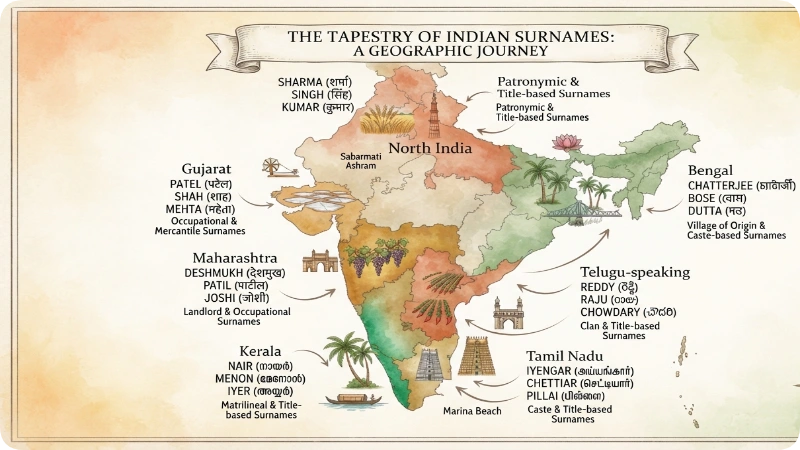
Indian surnames become much easier to understand when viewed geographically.
North Indian Last Names
Commonly encountered names include:
- Sharma
- Singh
- Gupta
- Verma
- Mishra
- Yadav
- Agarwal
- Joshi
- Pandey
- Chauhan
- Kumar
- Thakur
North Indian naming traditions often preserve surnames connected with community, ancestry, occupation, title or lineage. But none of these associations should be used to make assumptions about an individual person today.
Bengali Last Names
Some highly recognizable Bengali surnames include:
- Banerjee
- Chatterjee
- Mukherjee
- Bose
- Sen
- Das
- Ghosh
- Roy
Banerjee, Chatterjee and Mukherjee are especially recognizable English spellings of longer Bengali forms such as Bandyopadhyay, Chattopadhyay and Mukhopadhyay.
Aesthetic impression: Bengali surnames often have a literary, artistic or intellectual feel in contemporary popular culture—but that is an aesthetic association, not an inherent quality of the people who carry them.
Gujarati Last Names
Popular Gujarati-associated surnames include:
- Patel
- Shah
- Mehta
- Desai
- Joshi
- Gandhi
Some of these developed from occupations or administrative titles. Patel, for example, is historically connected with village leadership, while Desai has an administrative/revenue history.
Marathi Last Names
Examples include:
- Deshmukh
- Patil
- Kulkarni
- Deshpande
- Joshi
- Tendulkar
- Chavan
- Jadhav
- Shinde
- Gaikwad
Marathi surname traditions are particularly diverse. A Marathi-language reference groups surnames into categories including place names, occupations, descriptive terms, animals, plants, materials and kinship terms.
South Indian Last Names
South Indian naming deserves special care because a fixed hereditary surname is not universal.
Names may incorporate:
- father’s name
- mother’s name
- village or house name
- ancestral name
- community name
- hereditary surname
Tamil naming practices, in particular, may use a father’s initial rather than a permanent family surname. Government standards explicitly recognize patronymics and village names as possible components of an Indian full name.
Examples of recognizable South Indian surnames include:
- Iyer
- Iyengar
- Nair
- Menon
- Pillai
- Reddy
- Rao
- Naidu
- Shetty
- Hegde
This is one reason it can be misleading to assume every Indian person has a Western-style first-name-plus-family-name structure.
Indian Surnames With a Powerful, Regal Feel
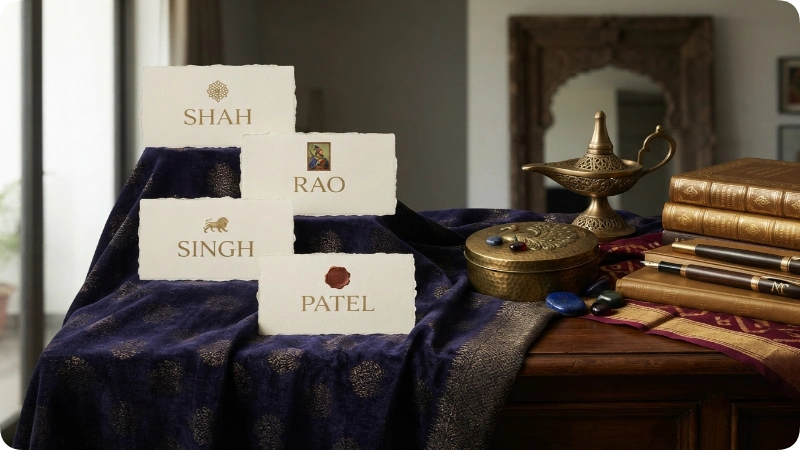
If you’re choosing a surname for a fictional character, pen name or creative project, sound matters almost as much as history.
| Surname | Emotional tone | Luxury / regal feel | Modernity |
| Shah | Commanding, polished | ★★★★★ | ★★★★☆ |
| Rao | Regal, concise | ★★★★☆ | ★★★★☆ |
| Singh | Heroic, forceful | ★★★★☆ | ★★★★★ |
| Patel | Established, confident | ★★★☆☆ | ★★★★★ |
| Mehta | Refined, professional | ★★★★☆ | ★★★★☆ |
| Desai | Distinguished | ★★★★☆ | ★★★★☆ |
| Chauhan | Martial, traditional | ★★★★☆ | ★★★☆☆ |
| Rajput | Warrior-associated | ★★★★★ | ★★★☆☆ |
The “luxury” and “modernity” ratings here are editorial aesthetic judgments, not cultural facts.
Soft, Elegant & Literary Indian Surnames
For a gentler or more literary sound, consider:
Bose · Sen · Roy · Anand · Das · Menon · Iyer · Banerjee · Mukherjee · Kapoor
These surnames pair especially well with short modern first names.
For example:
- Mira Sen — minimalist and literary
- Aanya Bose — soft and artistic
- Aria Kapoor — polished and cinematic
- Dev Anand — classic and memorable
- Rhea Menon — elegant and contemporary
Again, these combinations describe sound and naming aesthetics, not cultural prescriptions.
Indian Last Names With Strong Meanings
Some surnames stand out because their historical meanings are especially vivid.
| Surname | Meaning / sense | Emotional interpretation |
| Singh | Lion | Courage, strength |
| Sharma | Joy, comfort, shelter | Warmth, composure |
| Gupta | Guardian/protector | Security, intelligence |
| Patel | Village headman | Leadership, responsibility |
| Shah | King | Authority, grandeur |
| Rai | King | Nobility, confidence |
| Rao | Traditionally associated with rāja | Regal, concise |
| Das | Servant/devotee | Devotion, humility |
| Anand | Happiness, bliss | Warmth, optimism |
| Yadav | Associated with Yadu/Yadava lineage | Heritage, tradition |
The emotional interpretations are editorial naming language. They should not be confused with literal dictionary meanings.
Indian Muslim Last Names
Indian Muslim families use a wide range of surnames and naming traditions, including Arabic-, Persian-, Turkic- and locally rooted names.
Recognizable examples include:
- Khan
- Sheikh
- Qureshi
- Ansari
- Siddiqui
- Syed/Sayyid
- Ahmed
- Ahmad
Khan, for example, is a Turkic title that became widespread across Muslim societies and is now used by many families in South Asia. Indian Muslim naming is too diverse to reduce to one surname pattern.
For character naming, the best approach is to consider the specific regional and linguistic background for example, Urdu-speaking North Indian, Bengali Muslim, Kashmiri, Hyderabadi or Malayali Muslim traditions rather than treating “Indian Muslim” as a single naming system.
Indian Sikh Last Names
Sikh naming deserves its own category because Singh and Kaur have an unusually important religious and social history.
| Name | Traditional use | Meaning |
| Singh | Sikh men | Lion |
| Kaur | Sikh women | Royalty / princess |
| Gill | Common Sikh/Punjabi surname | Clan/community-associated surname |
| Sandhu | Common Punjabi/Sikh surname | Clan/community-associated surname |
| Brar | Punjabi surname | Clan/community-associated surname |
| Sidhu | Punjabi surname | Clan/community-associated surname |
The Sikh Coalition explains that Guru Gobind Singh established Singh and Kaur as shared names partly to undermine social barriers based on caste.
That history makes Singh more than simply a surname meaning “lion”: it also represents a deliberate form of collective identity and equality.
Indian Last Names and Caste: An Important Naming Note
Some Indian surnames have historically been associated with particular castes, communities or social roles.
That is a historical fact worth understanding, but it should not be turned into a shortcut for identifying an individual’s caste, religion, occupation or social status.
Surname histories can also change. Families adopt new names, spelling changes occur, people migrate, and surnames can cross community boundaries. A Marathi-language reference, for example, documents cases where surnames moved between communities over time.
For modern naming, therefore:
A surname may carry heritage without completely defining the person who carries it.
This distinction is especially important when choosing names for real children, fictional characters, genealogy projects or public-facing identities.
How to Choose an Indian Last Name for a Character
A convincing fictional Indian name should feel appropriate for the character’s region, language, family background and generation.
For a contemporary urban character
Try:
Sharma, Mehta, Kapoor, Shah, Patel, Gupta, Rao
These tend to be recognizable and relatively easy for international readers to pronounce.
For a Bengali literary character
Consider:
Sen, Bose, Banerjee, Chatterjee, Mukherjee, Ghosh
For a Punjabi/Sikh character
Consider:
Singh, Gill, Sandhu, Brar, Sidhu
But don’t automatically use Singh as shorthand for every Punjabi character; Punjabi identity and Sikh identity are not synonymous.
For a Kerala character
Consider:
Nair, Menon, Pillai
while checking the character’s specific family and community context.
For a Tamil character
Research the family’s actual naming structure before simply adding a Western-style surname. A patronymic or initial-based construction may be more culturally natural.
Best Indian Last Names for International Use
If your priority is easy pronunciation + recognizable Indian identity + professional appearance, these are particularly versatile:
- Sharma
- Patel
- Singh
- Gupta
- Mehta
- Shah
- Rao
- Kapoor
- Anand
- Sen
Best overall for versatility
Sharma — familiar, polished and widely recognizable.
Best for strength
Singh — exceptionally strong imagery because of its “lion” meaning and Sikh history.
Best for a polished modern feel
Mehta — compact, professional and elegant.
Best for a sophisticated minimalist feel
Shah — short, memorable and historically connected with the Persian title “king.”
Best for a literary feel
Sen — brief, refined and strongly associated with Bengali naming traditions.
Lucky Numbers, Colors, Gemstones and Zodiac Signs
You may see surname websites assigning lucky numbers, colors, gemstones, weekdays, zodiac signs and numerology values to Indian surnames.
These should not be presented as verified properties of a surname.
There is no scientifically established system by which a surname objectively determines:
- lucky number
- lucky color
- gemstone
- weekday
- zodiac sign
- personality
- destiny
A person’s zodiac sign is normally determined from birth information, not their surname. Numerology is a belief-based interpretive system rather than an established linguistic property of a name.
For a responsible names website, these attributes should therefore be labeled “numerology tradition,” “astrological tradition,” or “modern naming lore” if included at all.
That distinction is especially important when readers are choosing a real child’s name.
Do Indian Last Names Have Gender?
Usually, a hereditary surname itself is not inherently gendered in the way some given names are.
For example:
- Sharma can be used by men and women.
- Patel can be used by men and women.
- Gupta can be used by men and women.
- Singh traditionally has a specific masculine Sikh role.
- Kaur traditionally has a specific feminine Sikh role.
The wider naming system matters more than trying to classify every surname as simply “male” or “female.”
Modern Indian Surname Trends
Modern Indian naming is increasingly shaped by migration, international education, social media, entertainment and bureaucratic systems.
A person may encounter several naming conventions during a lifetime: a family or community name at home, an abbreviated form at school, a different ordering on an international document, and a standardized version on a passport.
India’s government data standards explicitly allow for names containing combinations of given names, surnames, patronymics, metronymics, village names and other culturally meaningful elements.
This is why “What is the Indian last name?” can sometimes be the wrong question.
The better question may be:
Which part of this person’s full name functions as the family name in this particular cultural and administrative context?
How Indian Last Names Sound With First Names
When choosing a surname for a baby, character or pen name, say the complete name aloud.
Smooth and contemporary
- Aarav Mehta
- Riya Shah
- Arjun Patel
- Mira Sen
- Kabir Anand
Traditional and substantial
- Arjun Sharma
- Vikram Singh
- Aditya Gupta
- Priya Iyer
- Neha Banerjee
Short-first-name + short-surname combinations
These have a particularly clean modern rhythm:
- Dev Shah
- Ria Sen
- Jai Rao
- Ana Bose
- Sam Mehta
Longer, more formal combinations
- Ananya Chatterjee
- Aditya Mukherjee
- Arjun Chakraborty
- Siddharth Deshmukh
The best pairing depends on syllable rhythm. A long first name often benefits from a compact surname, while a short first name can carry a more elaborate surname beautifully.
Quick Comparison: Which Indian Surname Fits Your Style?
| If you want… | Consider |
| Strong and heroic | Singh |
| Scholarly and classic | Sharma |
| Protective symbolism | Gupta |
| Leadership | Patel |
| Regal | Shah, Rao |
| Literary | Sen, Bose |
| Bengali identity | Banerjee, Chatterjee, Bose |
| Gujarati identity | Patel, Shah, Mehta, Desai |
| Marathi identity | Deshmukh, Patil, Kulkarni |
| Kerala identity | Nair, Menon, Pillai |
| Tamil identity | Iyer, Iyengar* |
| Telugu identity | Reddy, Naidu |
| Sikh identity | Singh, Kaur |
| Broad international usability | Sharma, Patel, Gupta, Mehta |
*Regional and community context still matters; a surname alone should not be treated as a complete cultural biography.
FAQs About Popular Indian Last Names
What is the most popular Indian last name?
There is no reliable, universally accepted national ranking of Indian surnames. Singh, Sharma, Patel, Gupta and Kumar are among the most widely recognized, but popularity varies substantially by region, language and community.
What are the top 10 Indian surnames?
A practical recognition-based list is Sharma, Singh, Patel, Gupta, Kumar, Yadav, Reddy, Nair, Iyer and Mehta. This is not an official population ranking.
What is the most common surname in India?
No authoritative current nationwide surname census establishes one definitive #1 surname. Some online databases publish rankings, but their population estimates are not equivalent to official Indian census statistics.
What does Sharma mean?
Sharma is derived from Sanskrit and is associated with meanings such as joy, comfort and shelter. It has traditionally been associated with Brahmin communities.
What does Singh mean?
Singh comes from Sanskrit siṃha, meaning lion. It has a particularly important role in Sikh identity through the tradition established by Guru Gobind Singh.
What does Patel mean?
Patel developed from a title associated with village leadership and landholding, particularly in Gujarat, before becoming a hereditary surname.
What does Gupta mean?
Gupta derives from Sanskrit goptṛ, associated with a guardian or protector. Historically, it has been used by more than one community in northern and eastern India.
Why don’t all Indians have surnames?
Indian naming systems vary enormously. In parts of South India, patronymics, initials, village names and other naming elements can be more important than a fixed hereditary family surname. Government naming standards explicitly accommodate these different structures.
Are Indian surnames connected to caste?
Some historically are, while others reflect occupations, geography, titles, religion or ancestry. However, surname associations should not be treated as a reliable way to identify an individual’s caste today.
Are Singh and Kaur surnames?
They can function as surnames. In Sikh tradition, Singh is associated with Sikh men and Kaur with Sikh women; the names were intended to help establish a shared Sikh identity that challenged caste distinctions.
Final Thoughts
The most beautiful thing about Indian last names is their variety.
Sharma can feel scholarly. Singh carries the image of a lion. Patel recalls village leadership. Gupta evokes protection. Shah feels compact and regal. Sen feels literary. Iyer, Nair, Reddy, Desai, Banerjee and hundreds of others open doors into particular linguistic and regional histories.
But a surname should never be reduced to a personality label.
The strongest naming choice is the one that fits the person, place, family, language and story while sounding natural when spoken aloud. For fictional characters especially, cultural specificity will almost always create a more convincing name than choosing a surname simply because it “sounds Indian.”
And for real families, heritage can be meaningful without becoming a rule: modern Indian naming is flexible, multilingual and constantly evolving.
/popular-indian-last-names

Amara uncovers the hidden history, origins, and meanings behind names. She curates Namestylo’s historical, cultural, and baby naming guides to ensure every suggestion carries deep significance. In her free time, she devours historical fiction and mythology.