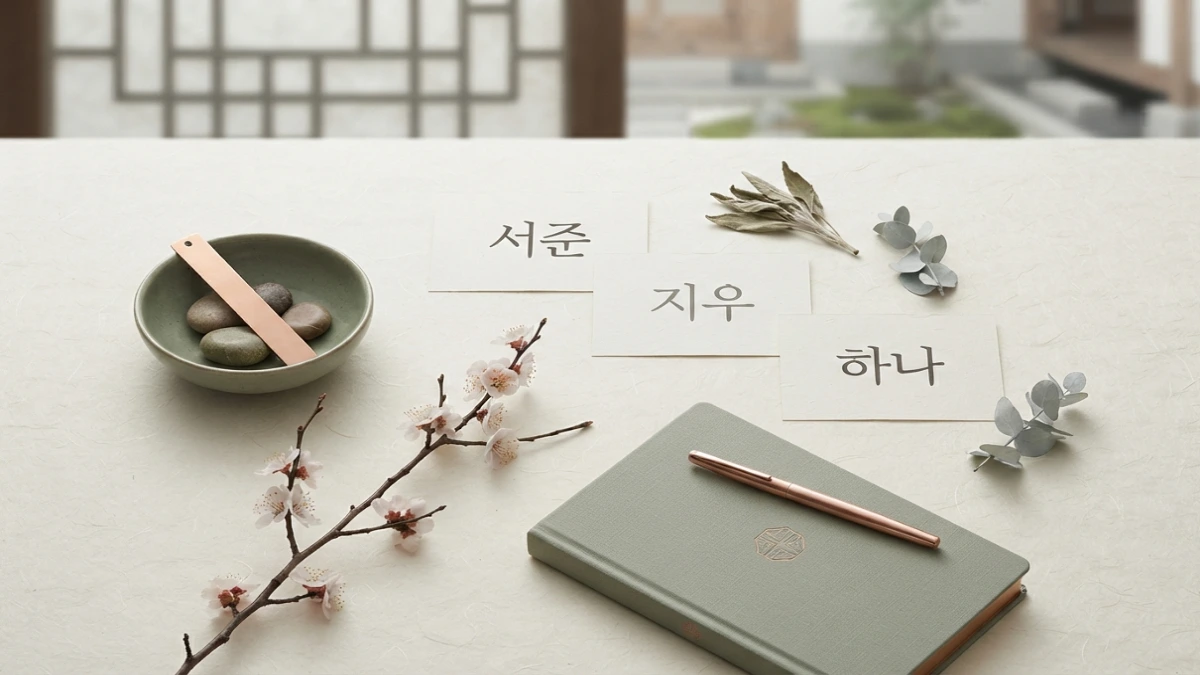
Korean names can feel wonderfully understated: soft syllables, elegant sounds, and meanings that can range from nature and beauty to wisdom, virtue, and strength.
But choosing a Korean name is about more than finding something that sounds beautiful. A Korean given name can carry a particular Hanja meaning, be written entirely in native Korean vocabulary, or be chosen primarily for its sound and contemporary feel. The same romanized spelling can also represent different Korean names depending on the Hangul and Hanja involved.
That makes Korean naming both fascinating and surprisingly nuanced.
If you’re choosing a name for a baby, a fictional character, a Korean inspired username, or simply exploring names such as Seo yeon, Ji woo, Ha neul, Min jun, or Areum, this guide focuses on what the names feel like as well as what they mean.
Korean Names at a Glance
Korean names are usually written with the family name first and the given name afterward in Korean naming order. Given names are commonly two syllables, although one syllable and other structures also exist. Many given names use Hanja, while native Korean names use Korean vocabulary instead.
| Feature | What to know |
| Writing system | Hangul is the Korean alphabet |
| Traditional structure | Family name + given name |
| Common given name pattern | Two syllables |
| Hanja names | Meaning depends on the chosen Hanja characters |
| Native Korean names | Built from Korean words rather than Hanja |
| Gender | Some names are strongly gender associated; others are unisex |
| Romanization | Several spellings may be encountered |
| Overall style | Classic, literary, nature inspired, modern, or minimalist |
Korean orthographic guidance treats the family name and given name as a unified personal name in Korean writing, while distinctions can matter when names are romanized or presented internationally.
What Makes a Korean Name Feel Beautiful?

The appeal of Korean names often comes from sound + visual simplicity + meaning rather than elaborate spelling.
A name such as Ji woo feels clean and contemporary. Ha neul has an airy, natural quality because haneul is the Korean word for “sky.” Areum, associated with the Korean word for “beauty,” feels warmer and more distinctly native Korean.
For Hanja based names, however, it is important not to assign one fixed English meaning to the romanized name alone. Different Hanja can be selected for the same Korean syllable, producing different meanings.
So a useful naming rule is:
Treat the Korean spelling and chosen Hanja as the authoritative meaning not the English gloss attached to a romanized name on a baby name list.
Korean Names by Style
If you’re choosing primarily by vibe, these categories can make the search much easier.
| Style | Names to explore | Overall impression |
| Soft & elegant | Seo yeon, Ha eun, Su a | Graceful, gentle, polished |
| Modern & clean | Ji woo, Seo jun, Do yun | Minimal, contemporary |
| Strong & composed | Min jun, Ji ho, Tae yang | Confident, energetic |
| Nature inspired | Ha neul, Ga eul, Bo ra | Airy, seasonal, vivid |
| Native Korean | Areum, Nuri, Sarang | Distinctively Korean, lyrical |
| Unisex feel | Ji woo, Su bin, Ha neul | Flexible and contemporary |
| Classic | Mi sook, Young sook, Jung ho | Traditional, familiar, generational |
| Literary/aesthetic | Ha neul, Ga eul, Areum | Poetic, visual, evocative |
These are aesthetic groupings, not claims about official gender classification or popularity. Korean names can shift in social perception across generations, and a name that feels traditional to one age group may feel nostalgic or distinctive to another.
Beautiful Korean Girl Names
Seo yeon (서연)
Seo yeon has a polished, graceful sound. It is especially attractive for parents who want something feminine without feeling overly ornate.
Because Seo and yeon can correspond to multiple Hanja, the exact meaning should be determined from the Hanja selected for the individual name.
Vibe: elegant, intelligent, refined
Aesthetic: minimalist luxury
Style: modern classic
Nicknames: Seo, Yeon
Best for: a sophisticated contemporary name
Ha eun (하은)
Ha eun has a soft rhythm and a warm emotional quality. Depending on the Hanja combination, the name can carry different meanings.
It works particularly well for someone looking for a name that feels gentle but not childish.
Vibe: kind, serene, graceful
Aesthetic: soft Korean minimalism
Style: modern classic
Nicknames: Ha, Eun
Best for: a warm and elegant impression
Su a (수아)
Short, bright, and easy to pronounce internationally, Su a has a delicate quality.
Its exact meaning depends on the Korean spelling and, where applicable, the Hanja selected.
Vibe: youthful, polished, cheerful
Aesthetic: clean and delicate
Style: modern
Nicknames: Su
Best for: families wanting a compact name with international usability
Bo ra (보라)
Bo ra is especially interesting because bora is also the Korean word for purple.
That gives the name an unusually direct visual association compared with many Hanja based names.
Vibe: artistic, colorful, distinctive
Aesthetic: violet, dreamy, creative
Style: native Korean / modern
Nicknames: Bo
Best for: a memorable nature or color inspired identity
Beautiful Korean Boy Names

Seo jun (서준)
Seo jun has a sleek, contemporary sound. As with many two syllable Korean names, its precise meaning depends on the Hanja selected.
It feels particularly versatile: youthful enough for a child, but polished enough for an adult.
Vibe: composed, intelligent, modern
Aesthetic: understated sophistication
Style: contemporary
Nicknames: Seo, Jun
Best for: a polished modern character or baby name
Min jun (민준)
Min jun has a balanced sound that combines softness with a more traditionally masculine impression in many naming contexts.
Its meaning is not fixed by the romanization; different Hanja combinations can produce different interpretations.
Vibe: capable, bright, dependable
Aesthetic: clean and classic
Style: modern classic
Nicknames: Min, Jun
Best for: someone wanting a versatile, established feeling name
Ji ho (지호)
Short and energetic, Ji ho has a crisp two syllable rhythm.
As with other Hanja based Korean names, its meaning should be tied to the specific characters rather than to a single universal English translation.
Vibe: confident, bright, active
Aesthetic: minimalist
Style: contemporary classic
Nicknames: Ji, Ho
Best for: a short, memorable Korean name
Do yun (도윤)
Do yun has a smooth, refined sound and works well for people seeking a name that feels sophisticated without being overly elaborate.
The meaning varies according to the Hanja chosen.
Vibe: calm, intelligent, sophisticated
Aesthetic: modern Seoul minimalism
Style: contemporary
Nicknames: Do, Yun
Best for: a refined modern identity
Beautiful Gender Neutral Korean Names

Korean also has names whose social impression can be relatively flexible across genders. The National Institute of Korean Language explicitly recognizes 중성적 이름 (jungseongjeok ireum, “unisex/gender neutral name”) as a concept in Korean usage.
Ji woo (지우)
Ji woo is one of the most appealing choices for someone seeking a name with a gentle, contemporary sound.
Its exact meaning depends on the Hanja selected.
Vibe: calm, intelligent, artistic
Aesthetic: modern and understated
Gender feel: relatively flexible
Style: contemporary
Nicknames: Ji, Woo
Su bin (수빈)
Su bin has a balanced sound and can work beautifully when the goal is a name that does not immediately feel heavily gendered.
Again, the meaning is Hanja dependent.
Vibe: bright, composed, approachable
Aesthetic: clean and youthful
Gender feel: flexible
Style: modern classic
Nicknames: Su, Bin
Ha neul (하늘)
Unlike many Hanja based names, Ha neul can be understood directly through Korean vocabulary: haneul means “sky.”
That gives it an immediate poetic image open space, height, freedom, and light.
Those emotional associations are an interpretation of the word’s imagery, not an additional traditional etymology.
Vibe: free, peaceful, expansive
Aesthetic: sky, clouds, open landscapes
Gender feel: flexible
Style: native Korean / poetic
Nicknames: Ha
Native Korean Names With Beautiful Meanings

Native Korean names deserve special attention because their structure can be quite different from Hanja based names.
Areum (아름)
Areum is associated with the Korean word 아름, meaning “beauty” in the relevant native Korean vocabulary.
It has an unmistakably lyrical quality and feels more poetic than formal.
Vibe: beautiful, artistic, gentle
Aesthetic: flowers, light, poetry
Style: native Korean
Social impression: distinctive and expressive
Nuri (누리)
Nuri is associated with native Korean vocabulary connected with the world or the broad world around us.
It has an expansive, optimistic quality and a simple two syllable structure.
Vibe: open, bright, worldly
Aesthetic: nature and wide landscapes
Style: native Korean
Social impression: warm and distinctive
Sarang (사랑)
Sarang is the Korean word for love.
Few names make their emotional theme as immediately transparent as this one.
That directness can be a strength if you’re choosing a character name, creative identity, or meaningful Korean inspired name. For a real life Korean naming decision, however, cultural context and contemporary usage matter just as much as the dictionary meaning.
Vibe: affectionate, heartfelt, warm
Aesthetic: romantic and lyrical
Style: native Korean
Emotional association: love and affection
Ga eul (가을)
Ga eul means “autumn” in Korean.
It has a distinctly seasonal aesthetic: amber leaves, cool air, quiet streets, and the reflective mood associated with autumn.
Vibe: calm, artistic, mature
Aesthetic: autumn, leaves, warm neutrals
Style: native Korean
Emotional association: seasonal beauty
Korean Names Inspired by Nature
Nature vocabulary can produce especially memorable Korean names because the imagery is immediately understandable.
| Name | Korean | Literal/linguistic association | Emotional vibe |
| Ha neul | 하늘 | Sky | Free, expansive |
| Ga eul | 가을 | Autumn | Reflective, warm |
| Bo ra | 보라 | Purple | Artistic, vivid |
| Nuri | 누리 | World | Open, optimistic |
| Saet byeol | 샛별 | Morning star | Bright, poetic |
| Haet bit | 햇빛 | Sunlight | Warm, radiant |
Some of these are better treated as native Korean words or poetic naming inspirations than as conventional assumptions about contemporary Korean given name frequency. That distinction matters when a name is being chosen for an actual person.
Korean Names With a Soft, Elegant Vibe
If sound matters more to you than literal meaning, look for names with open vowels, smooth syllable transitions, and a gentle final syllable.
Soft and elegant choices:
- Seo yeon
- Ha eun
- Su a
- Ji woo
- Ye rin
- Eun seo
- Chae won
- Yu na
- A ra
- Ha neul
The emotional descriptions here are aesthetic interpretations, not dictionary meanings. A name can sound soft without having a “soft” literal meaning.
Korean Names With a Strong or Powerful Vibe
For a more commanding impression, names with sharper consonant patterns or traditionally strength associated Hanja can create a different effect.
Consider:
- Tae ho
- Ji ho
- Min jun
- Hyun woo
- Do yun
- Seung ho
- Jun ho
- Tae yang
For Hanja names, verify the exact characters before attaching meanings such as “strength,” “wisdom,” “victory,” or “greatness.” The same Hangul syllable can represent different Hanja and therefore different semantic interpretations.
Korean Names: Hanja vs Native Korean
One of the most important distinctions for anyone researching Korean names is the difference between Hanja based names and native Korean names.
Hanja based names
Many Korean given names can be written using Hanja, Chinese characters historically used in Korean writing. A syllable such as jun, ji, seo, or min does not automatically have one fixed meaning.
The selected Hanja determines the semantic layer.
For example, a romanized form such as Ji woo is not enough to establish a single literal translation. You need the Hangul and the particular Hanja, if Hanja are being used.
Native Korean names
Native Korean names use Korean vocabulary rather than relying on Hanja characters for their meaning.
Examples include:
- Ha neul sky
- Ga eul autumn
- Sarang love
- Bo ra purple
- Areum associated with beauty
The National Institute of Korean Language has also documented discussion around Korean names formed from native Korean words, including examples such as Nuri, Ga eul, and other word based names.
Korean Name Meanings: Why Online Lists Can Be Misleading
A common mistake is to search for a Korean name, find an English meaning, and assume that meaning applies universally.
It often doesn’t.
Korean syllable ≠ one permanent meaning.
The same syllable can be represented by different Hanja. Conversely, a native Korean name may have a direct vocabulary meaning rather than a Hanja derived meaning.
So when evaluating a name, use this hierarchy:
- Hangul spelling
- Chosen Hanja, if applicable
- Verified Korean dictionary meaning
- Cultural context
- Personal aesthetic interpretation
This keeps a beautiful emotional association from accidentally being presented as historical etymology.
Lucky Numbers, Colors, Stones and Zodiac Associations
Many Korean name websites attach attributes such as lucky numbers, colors, gemstones, days, or zodiac signs to names.
These should be treated as optional numerology or modern naming entertainment, not inherent properties of Korean names.
There is no universal rule that makes a particular Korean name inherently “lucky” because it has a certain number, gemstone, or color.
For example:
| Attribute | How to use it responsibly |
| Lucky number | Personal/numerology association |
| Lucky color | Aesthetic or symbolic association |
| Lucky stone | Modern symbolic pairing |
| Lucky day | Personal or numerological tradition |
| Zodiac | Birth date system, not name etymology |
| Numerology | Interpretive belief system |
| Personality | Aesthetic impression, not a prediction |
Naming tip: If you’re publishing a Korean name guide, label these attributes as modern associations rather than presenting them as traditional Korean facts.
Korean Name Comparison: Which Style Fits You?
| Name | Tone | Elegance | Softness | Distinctiveness | Modern feel |
| Seo yeon | Refined | High | High | Medium | High |
| Ji woo | Calm | High | High | Medium | High |
| Ha neul | Poetic | High | High | High | High |
| Areum | Artistic | High | High | High | Medium |
| Bo ra | Vivid | Medium | Medium | High | Medium |
| Ha eun | Gentle | High | High | Medium | High |
| Seo jun | Polished | High | Medium | Medium | High |
| Min jun | Confident | High | Medium | Medium | High |
| Ji ho | Energetic | Medium | Medium | Medium | High |
| Ga eul | Literary | High | Medium | High | High |
These ratings describe editorial naming impressions, not objective measurements of the people who have these names.
How to Choose a Korean Name for a Baby
If you’re choosing a name for a real child, sound alone should not be the final test.
Consider these questions:
1. What will the name look like in Hangul?
A romanized spelling can hide important differences. Decide on the Korean spelling first.
2. Does it have a specific Hanja meaning?
If yes, confirm the exact characters. Don’t rely on a generic website translation.
3. How does it sound with the family name?
Say the entire name aloud several times.
A beautiful given name may sound unexpectedly different when combined with a particular surname.
4. Will it work internationally?
If the child will live outside Korea, consider how easily the name can be pronounced, typed, remembered, and written in Roman letters.
Korean romanization can produce different practical spellings. The National Institute of Korean Language, for example, gives Baek Ihyeon as a Romanized form for 백이현 and notes that Baek I hyeon is also permitted under the relevant romanization guidance.
5. Does it still feel right for an adult?
Imagine the name on:
- a school notebook
- a university application
- a business card
- a wedding invitation
- a professional email
- a passport
A name should have room to grow.
How to Choose a Korean Name for a Character
For fiction, the priorities can be different.
Character’s name should reinforce their identity without becoming a stereotype.
Gentle protagonist: Ha neul, Ji woo, Seo yeon
Ambitious character: Seo jun, Min jun, Do yun
Artistic character: Areum, Bo ra, Ga eul
Mysterious character: choose a name with a restrained sound and let the character’s actions not the name’s supposed “meaning” create the mystery.
Korean characters specifically, research the character’s generation, family background, and setting. A name that sounds natural for a teenager today may feel conspicuously old fashioned for a child, or perfectly appropriate for an older character.
Sibling Names That Sound Good Together
Sibling compatibility is mostly about rhythm rather than forcing identical meanings.
Some combinations with a cohesive modern feel include:
- Ji woo & Seo jun
- Ha eun & Min jun
- Seo yeon & Ji ho
- Ha neul & Areum
- Su a & Do yun
- Ga eul & Nuri
A useful rule is to avoid making every sibling name follow exactly the same pattern unless that is an intentional family naming tradition.
For example, two short names can sound beautifully coordinated without needing matching initials or identical meanings.
Korean Names for Online Names, Characters and Creative Projects
For usernames, game characters, fantasy characters, or creative identities, you have more freedom.
Names with particularly strong visual identities include:
Ha neul sky imagery
Ga eul autumn imagery
Bo ra purple imagery
Sarang love imagery
Areum beauty imagery
Nuri world imagery
These can work especially well with visual platforms such as Pinterest or character focused communities because the underlying Korean vocabulary creates an immediate conceptual image.
Just distinguish between a Korean word used creatively and a conventional Korean personal name. They are not always interchangeable.
Korean Naming Style and Modern Culture
Korean naming culture continues to exist within a changing linguistic environment. The National Institute of Korean Language’s recent language research, for example, has documented differences in word preferences across generations and a growing use of more neutral forms of address among younger speakers.
That does not mean every Korean naming convention is rapidly changing, but it does highlight an important principle: Korean names should be understood in generational context.
For naming research, this is more useful than simply labeling a name “modern” or “traditional.”
A name can be:
- historically established but fashionable again,
- common in one generation but unusual in another,
- contemporary without being newly invented,
- native Korean without being a newly created name,
- or globally recognizable without being especially common in Korea.
Korean Name Pronunciation and Romanization
Korean names are generally best understood from their Hangul spelling, not from English pronunciation guesses.
Romanization is useful for international readers, but it cannot perfectly communicate every Korean sound to an English speaking reader.
When writing names for an English language website, consider displaying:
Hangul → Romanization → meaning/meaning source
For example:
하늘 → Ha neul → “sky”
This gives readers both the original Korean identity and an accessible Romanized form.
Quick Korean Name Finder
For a soft girl name
Seo yeon, Ha eun, Su a, Ye rin
For a modern boy name
Seo jun, Min jun, Do yun, Ji ho
For a gender neutral feel
Ji woo, Su bin, Ha neul
For a nature inspired name
Ha neul, Ga eul, Bo ra
For a poetic native Korean name
Areum, Nuri, Sarang
For a short and memorable name
Su a, Ji ho, Nuri, A ra
Frequently Asked Questions
What are the most beautiful Korean names?
Beauty is subjective, but names such as Seo yeon, Ji woo, Ha eun, Ha neul, Areum, Seo jun, and Do yun offer different kinds of appeal from elegant and soft to modern and refined.
Do Korean names have meanings?
Yes, but the meaning depends on the type of name. Hanja based names derive their semantic meaning from the selected Hanja, while native Korean names can come directly from Korean vocabulary.
Are Korean names gender neutral?
Some Korean given names have relatively flexible gender associations. Ji woo, Su bin, and Ha neul, for example, can have a more gender neutral impression. Gender associations can change by generation and social context.
Why do Korean names have two syllables?
Two syllable given names are a familiar and important pattern in modern Korean naming, although Korean names are not limited to two syllables.
Does a Korean name have one fixed English meaning?
Not necessarily. A romanized name may represent several possible Hanja combinations. Always verify the Hangul and Hanja before assigning a definitive meaning.
Can I use a Korean word as a name?
Some native Korean words are used as names, but a word that sounds beautiful is not automatically a conventional personal name. For a real person’s name, cultural and contemporary usage should be researched alongside the literal meaning.
How should Korean names be written in English?
There can be variation in Roman letter spellings, particularly in personal usage and official documents. The Korean spelling should be established first, followed by an appropriate romanization.
Final Thoughts
The most memorable Korean names are not necessarily the ones with the longest lists of meanings.
They are the names where sound, writing, cultural context, and personal meaning come together.
Choose Ha neul if you love the openness of the sky. Choose Ga eul for the quiet beauty of autumn. Choose Sarang when the direct symbolism of love matters most. Choose a Hanja based name when you want a carefully selected semantic meaning that can belong specifically to the person who carries it.
And above all, don’t let an English baby name list make a Korean name seem simpler than it really is.
The Hangul matters.
The Hanja matters.
The generation matters.
The family matters.
And, ultimately, the feeling the name gives you matters too.

Amara uncovers the hidden history, origins, and meanings behind names. She curates Namestylo’s historical, cultural, and baby naming guides to ensure every suggestion carries deep significance. In her free time, she devours historical fiction and mythology.