SEO Title: SNAFU Meaning in Text: What Does It Really Mean?
Introduction
Ever received a text saying, “Sorry, it’s a bit of a SNAFU right now,” and wondered what that actually means?
You’re not alone. SNAFU is one of those unusual internet expressions that can make an ordinary conversation sound confusing until you know its meaning. It often appears in text messages, workplace chats, online discussions, gaming conversations, and social media posts.
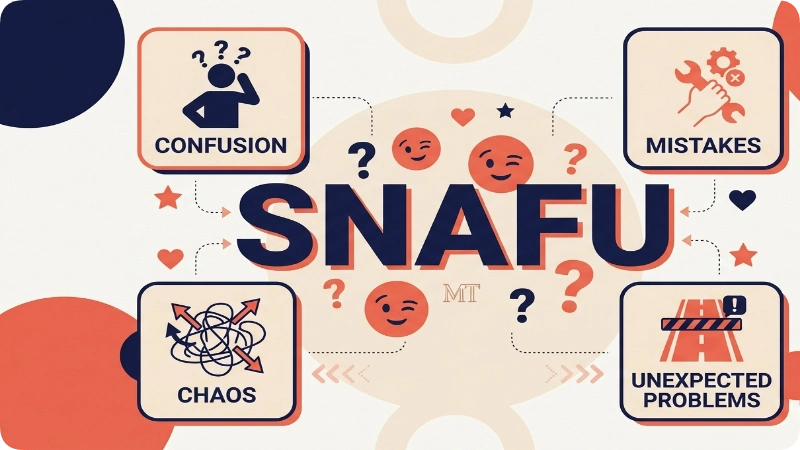
In simple terms, SNAFU means that something has gone wrong, become disorganized, or turned into a complete mess. It’s usually used humorously or sarcastically to describe a situation that isn’t going according to plan.
But there’s more to this expression than its casual online use. SNAFU has military roots, a memorable history, and a personality that makes it different from ordinary words like problem or mistake.
Let’s explore what SNAFU means in text, how people use it, and how to understand it when someone sends it your way.
Featured Snippet: What Does SNAFU Mean in Text?
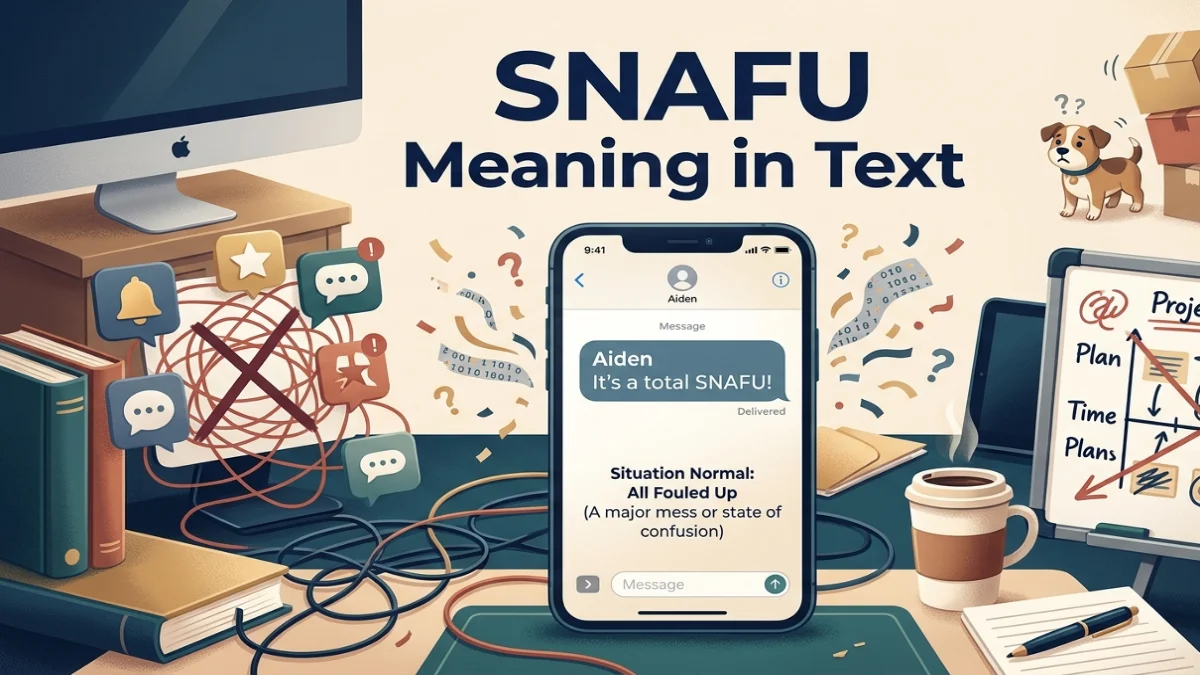
SNAFU means “Situation Normal: All Fouled Up” (with a historically vulgar original wording). In texting, it describes a chaotic, messy, confusing, or badly organized situation. People commonly use it humorously or sarcastically when things go wrong.
Example:
“Sorry I’m late. The whole morning has been a SNAFU.”
Meaning: The morning was chaotic, and several things went wrong.
SNAFU Meaning and Overview
SNAFU is an informal English expression that can function as a noun, adjective, or verb. Although people sometimes treat it like a modern texting abbreviation, it actually dates back to the 1940s.
| Detail | Meaning |
| Word | SNAFU |
| Full form | Situation Normal: All Fouled Up |
| Original wording | Situation Normal: All F***ed Up |
| Type | Military acronym and informal slang |
| Tone | Humorous, sarcastic, informal |
| Common meaning | Mess, confusion, mistake, or unexpected problem |
| Pronunciation | SNA foo |
| Origin | American military slang, World War II |
| Plural | SNAFUs |
The word has evolved from a military expression into a recognizable term for everyday confusion, technical problems, administrative mistakes, and unexpected complications.
Dictionary.com+2
Where Did SNAFU Come From?
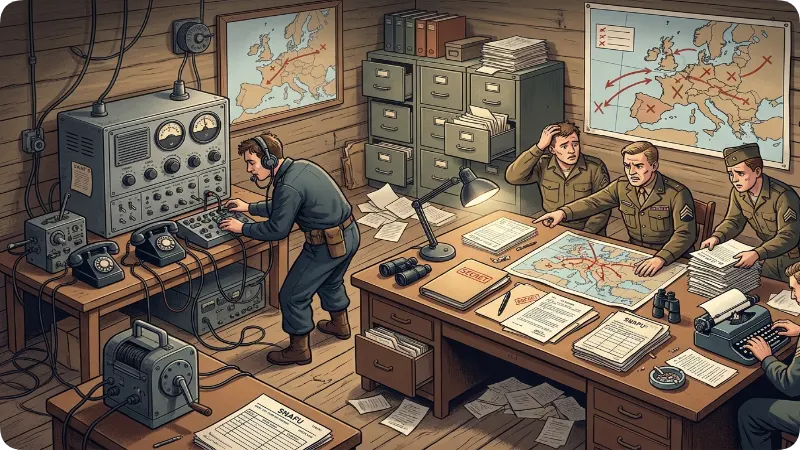
SNAFU originated as American military slang during World War II in the early 1940s.
Soldiers used it to describe situations where everything was going wrong, yet that kind of disorder seemed almost normal. Its original full form contained profanity, reflecting the frustration and dark humor associated with military life.
The expression was also a sarcastic way of acknowledging that confusion, poor planning, and unexpected problems were part of everyday military operations.
Over time, the phrase moved beyond military conversations and became part of everyday English.
Today, people use SNAFU to describe everything from a computer malfunction to a delayed appointment or a badly organized office project.
Interestingly, the word is sometimes written as though its original expansion were completely polite. The phrase “Situation Normal: All Fouled Up” is a softened version of the original expression.
Etymology, Origin & Meaning+2
How Is SNAFU Used in Text Messages?
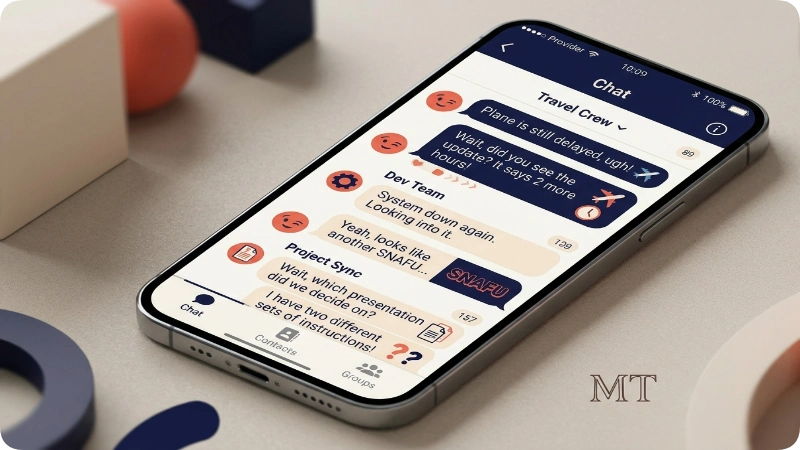
In texting, SNAFU usually communicates that something has gone wrong without requiring a long explanation.
It can make a frustrating situation sound slightly funny, especially when the person writing it wants to acknowledge a problem without becoming overly serious.
Here are some common texting situations.
1. When Plans Go Wrong
Text: “Our weekend trip is turning into a SNAFU.”
Meaning: The trip arrangements have become confusing or complicated.
2. When Technology Stops Working
Text: “The website update caused a complete SNAFU.”
Meaning: Something went wrong with the website, creating unexpected problems.
3. When Work Becomes Chaotic
Text: “Today’s office schedule is a total SNAFU.”
Meaning: The work schedule is disorganized, and things aren’t happening as planned.
4. When Someone Makes a Mistake
Text: “There was a SNAFU with my booking.”
Meaning: A mistake or mix up happened during the booking process.
5. When Someone Uses Sarcasm
Text: “Another Monday, another SNAFU. Just wonderful!”
Meaning: The person is sarcastically expressing frustration because something has gone wrong again.
What Does SNAFU Mean Depending on the Context?
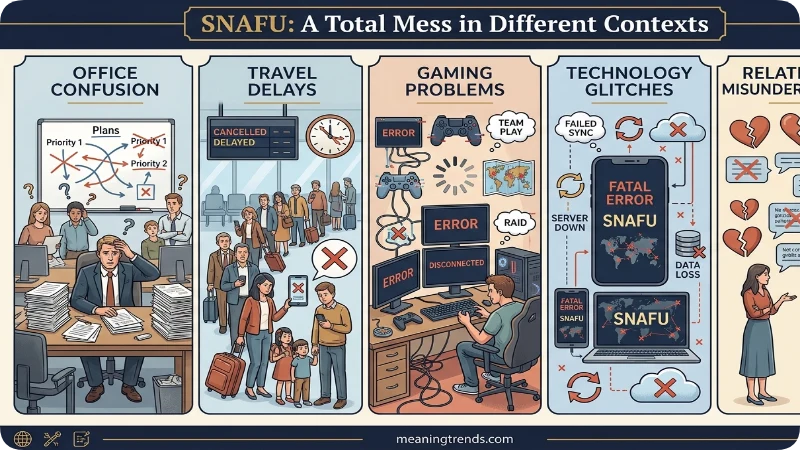
The exact feeling behind SNAFU can change depending on the conversation.
| Context | What SNAFU Suggests |
| Friendship | A funny or frustrating mix up |
| Workplace | Poor organization or an operational problem |
| Technology | A technical glitch or system failure |
| Relationships | Confusion or a misunderstanding |
| Gaming | A failed strategy or unexpected problem |
| Travel | Booking issues, delays, or disrupted plans |
| Social media | A chaotic or ridiculous situation |
Important: SNAFU doesn’t automatically mean something disastrous has happened. Sometimes it describes a relatively small inconvenience.
For example, forgetting your headphones might be a minor annoyance, while losing an important document could create a much bigger SNAFU.
Context determines how serious the situation really is.
Is SNAFU Rude or Offensive?
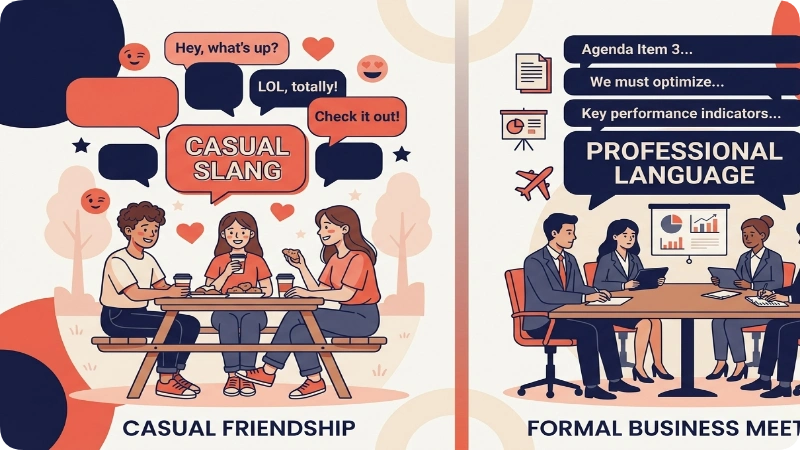
SNAFU is generally considered informal rather than inherently offensive.
However, its original meaning includes a swear word. This gives it a slightly edgy or blunt background, even when someone uses the polite expansion “all fouled up.”
In casual conversations, most people use it to express frustration, humor, or sarcasm.
Consider these situations:
- With friends: Usually acceptable in relaxed conversations.
- On social media: Fine in many informal posts and comments.
- At work: Can be acceptable among familiar colleagues, depending on company culture.
- In formal emails: Better to use professional alternatives.
- In academic writing: Generally avoid it unless discussing the word itself.
If you are unsure If someone might find it inappropriate, choose a softer expression such as “mix up” or “complication.”
SNAFU vs. FUBAR vs. Other Similar Expressions
SNAFU is often confused with other informal expressions that describe problems. However, these words don’t communicate exactly the same level of seriousness.
| Expression | Meaning | General Feeling |
| SNAFU | A confusing or badly organized situation | Frustrated, sarcastic |
| FUBAR | Something badly damaged or beyond repair | Much stronger and more serious |
| Mess | A disorganized situation | Casual |
| Mishap | An unfortunate mistake or accident | Mild |
| Glitch | A small technical or operational problem | Neutral |
| Chaos | Complete disorder or confusion | Strong |
| Mix up | A misunderstanding or accidental mistake | Mild |
SNAFU vs. FUBAR
These two expressions share military roots, but their meanings are different.
- SNAFU: A situation is going wrong, often in a way that feels frustratingly familiar.
- FUBAR: Something is so badly damaged or messed up that it may be beyond recovery.
For example:
“The meeting schedule is a SNAFU.”
This suggests confusion and disorganization.
“The entire system is FUBAR.”
This communicates a much more serious failure.
Because FUBAR contains explicit profanity in its original expansion, it is generally stronger and less suitable for professional conversations.
Etymology, Origin & Meaning+2
Can SNAFU Be Used as a Noun, Verb, or Adjective?
Yes. Although its original use was as an acronym, SNAFU has developed into a flexible English word.
SNAFU as a Noun
This is one of its most common modern uses.
Example: “There was a SNAFU with the delivery.”
Meaning: Something went wrong with the delivery.
SNAFU as an Adjective
It can describe something that is confused, disorganized, or chaotic.
Example: “The entire process is SNAFU.”
Meaning: The process is badly organized or not working properly.
SNAFU as a Verb
SNAFU can also be used informally as a verb meaning to mess something up or throw it into confusion.
Example: “The unexpected change snafued our plans.”
Meaning: The unexpected change disrupted the plans.
This verb form is less common than the noun form.
Collins English Dictionary+1
What Should You Reply When Someone Says SNAFU?
If someone sends you a message containing SNAFU, your response should depend on If they’re joking, complaining, or explaining a genuine problem.
Here are some natural replies:
| Situation | Possible Reply |
| They’re joking | “Sounds like a classic Monday!” |
| They’re frustrated | “Oh no, what happened?” |
| Plans have changed | “No worries, we’ll figure it out.” |
| Work is chaotic | “Hopefully things settle down soon.” |
| Something went wrong | “Got it. Let’s fix it.” |
| You’re sharing the frustration | “Seems like everything went sideways today!” |
You don’t need to use another acronym in response. A simple, friendly message is usually enough.
Is SNAFU Still Used in Modern Online Conversations?
Yes, SNAFU remains understandable in modern English, although it is not among the most universally recognized texting abbreviations.
Unlike expressions such as LOL, OMG, or BTW, SNAFU is more closely associated with informal vocabulary, workplace communication, military terminology, and discussions about complicated situations.
You might encounter it in:
- Reddit discussions about frustrating experiences.
- Gaming conversations about failed missions or strategies.
- Workplace Slack messages describing operational problems.
- Online discussions about technical failures.
- Casual conversations involving unexpected mistakes.
Its appeal comes partly from its sarcastic personality. Instead of simply saying something went wrong, SNAFU adds a little humor and a sense of familiar frustration.
It also has an old fashioned, slightly witty quality that makes it stand out from newer internet abbreviations.
Is SNAFU a Name or a Naming Term?
Although this article appears on a names and meanings website, SNAFU is not traditionally a personal name.
It is an acronym that developed into an informal English word. It does not have an established baby name meaning, traditional naming origin, or recognized cultural naming history.
However, it can be interesting for writers, gamers, and creative storytellers looking for unusual acronyms, fictional organization names, or humorous project titles.
Its personality is best described as:
- Personality: Sarcastic and witty.
- Aesthetic: Vintage military slang.
- Emotional energy: Frustrated but humorous.
- Style: Unconventional and informal.
- Creative association: Chaos, mishaps, and unexpected adventures.
If you’re considering SNAFU for a fictional character, gaming identity, or creative project, remember that its established meaning is strongly associated with disorder and things going wrong.
Frequently Asked Questions About SNAFU
1. What does SNAFU stand for in texting?
SNAFU stands for “Situation Normal: All Fouled Up.” Its original, more vulgar expansion uses a swear word instead of “fouled.” In texting, it describes a messy, confusing, or problematic situation.
2. Does SNAFU mean something went wrong?
Yes. It usually means that something has gone wrong, become disorganized, or developed into an unexpected problem.
3. Is SNAFU a bad word?
Not necessarily. The abbreviation itself is commonly used informally, but its original expansion contains profanity. Consider your audience before using it in professional or formal settings.
4. What does SNAFU mean in a relationship?
In a relationship conversation, SNAFU can describe a misunderstanding, communication problem, or complicated situation. The exact meaning depends on the surrounding messages.
5. What does SNAFU mean at work?
At work, SNAFU generally refers to an operational mistake, scheduling issue, administrative mix up, or poorly organized process.
6. How do you pronounce SNAFU?
SNAFU is pronounced “SNA foo.” It sounds like two syllables, with the emphasis on the first syllable.
7. Is SNAFU the same as FUBAR?
No. SNAFU generally describes a confusing or disorganized situation, while FUBAR describes something much more seriously damaged or messed up.
8. What is the plural of SNAFU?
The plural is SNAFUs. For example: “We experienced several SNAFUs during the event.”
9. Can I use SNAFU in a professional email?
You can use it in relaxed workplace communication, but it is better to choose alternatives such as “complication,” “operational issue,” or “unexpected problem” in formal emails.
10. Is SNAFU an outdated expression?
It originated in the 1940s, but it is still recognized and used in modern English. Its military background gives it a vintage quality, while its meaning remains relevant to everyday problems.
Conclusion:
SNAFU is more than just an unusual collection of letters. It is a humorous expression with a history rooted in military slang and a meaning that still fits everyday conversations.
When someone uses SNAFU in a text, they are usually describing a situation that has become confusing, disorganized, or unexpectedly problematic.
If it’s a delayed meeting, a technical failure, a travel mix up, or a day when absolutely nothing goes according to plan, SNAFU captures that familiar feeling of things going wrong.
The easiest way to remember it is simple: SNAFU means a situation that’s gone wrong, often with a touch of sarcasm or humor.

Amara uncovers the hidden history, origins, and meanings behind names. She curates Namestylo’s historical, cultural, and baby naming guides to ensure every suggestion carries deep significance. In her free time, she devours historical fiction and mythology.