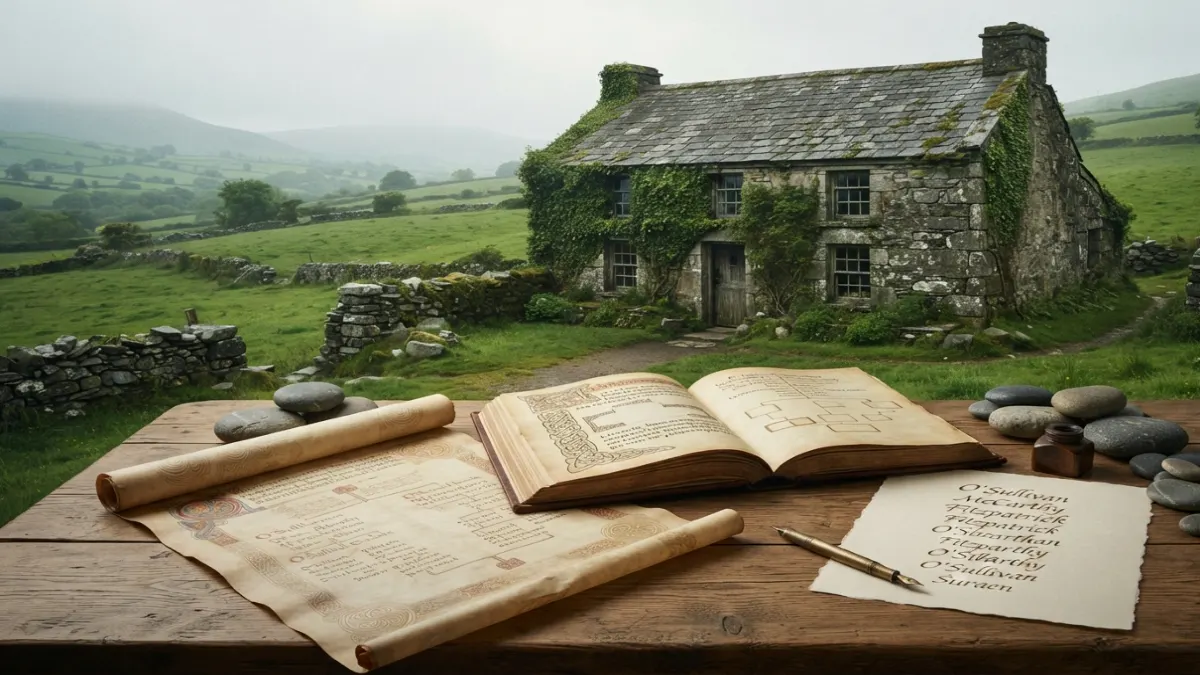
Irish last names carry something wonderfully human: a sense of ancestry without feeling frozen in the past. Some sound gentle and lyrical, others strong and unmistakable. Names such as Murphy, Kelly, O’Brien, Byrne, Sullivan, and O’Neill can feel familiar around the world while still pointing back toward Ireland’s Gaelic naming traditions.
If you are researching your family tree, choosing a surname for a character, looking for a meaningful family name, or simply falling in love with Irish naming style, the best Irish surnames offer more than a pretty sound. They carry layers of language, history, place, lineage, and identity.
Featured snippet
Irish last names are family names that developed from Gaelic patronymics, personal names, occupations, nicknames, places, and in some cases Norse, Norman, English, Scottish, or other influences. Traditional Gaelic surnames frequently use Ó, meaning descendant of, or Mac, meaning son of. Many were later anglicized into forms such as O’Brien, O’Neill, McCarthy, and Doyle.
Irish last names at a glance
| Surname | Traditional Irish form | Broad origin | Naming impression |
| Murphy | Ó Murchadha | Gaelic personal name | Warm, familiar, strong |
| Kelly | Ó Ceallaigh | Gaelic personal name | Classic, friendly |
| O’Brien | Ó Briain | Gaelic personal name | Noble, historic, commanding |
| Byrne | Ó Broin / Ó Birn | Gaelic/Norse linked traditions | Dark, dramatic, elegant |
| Ryan | Ó Riain | Gaelic personal name | Soft, modern classic |
| O’Connor | Ó Conchobhair | Gaelic personal name | Regal, powerful |
| Sullivan | Ó Súilleabháin | Gaelic personal name | Romantic, refined |
| O’Neill | Ó Néill | Gaelic personal name | Strong, aristocratic |
| Walsh | Breathnach | Gaelic ethnonym | Crisp, understated |
| Doyle | Ó Dubhghaile | Gaelic personal name | Sleek, literary |
| Gallagher | Ó Gallchobhair | Gaelic personal name | Bold, energetic |
| McCarthy | Mac Cárthaigh | Gaelic patronymic | Traditional, polished |
Important: the “naming impression” column is an editorial interpretation, not an etymological claim.
Why Irish surnames feel so distinctive
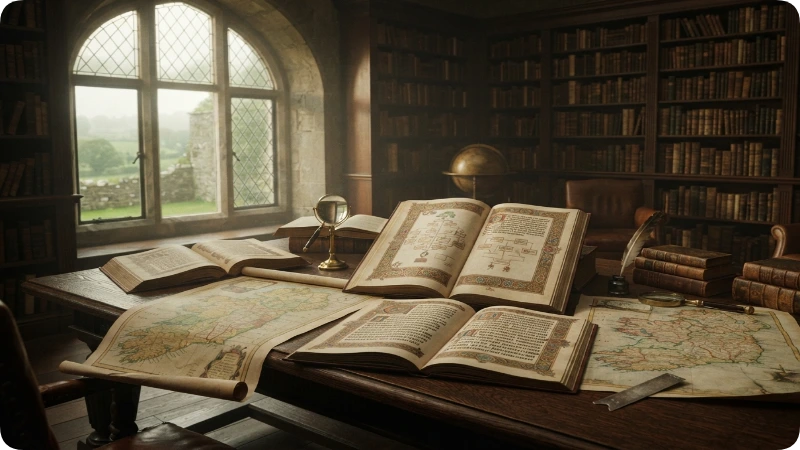
Irish family names developed gradually, with hereditary surnames becoming established over the medieval period. A major traditional pattern was to connect a family to an ancestor: Ó or Ua was associated with a grandson or descendant, while Mac meant son. Over time, these meanings broadened, and the prefixes became part of hereditary family names.
The result is a naming tradition that feels unusually personal. A surname was not simply an arbitrary label it could preserve a relationship with an ancestor.
There is also an important warning for genealogy: an English looking spelling does not necessarily mean an English origin, and the presence or absence of O’ or Mac does not by itself prove ancestry. Irish surnames were repeatedly anglicized, translated, shortened, or otherwise altered.
What do O’ and Ó mean?
Ó is the modern Irish form of an older patronymic element traditionally associated with “grandson” or “descendant.” In surnames, it came to identify descendants of a named ancestor.
Thus, Ó Briain became O’Brien, literally indicating descent from Brian. Historical sources also show that the O’ prefix was sometimes dropped and later restored, so spelling history can be complicated.
What does Mac mean in Irish surnames?
Mac traditionally means “son” and was used before an ancestor’s name. Irish surname scholarship distinguishes Mac surnames formed from native Irish names from those formed from names of foreign origin, including some Norse and Norman associated personal names.
That is why Mac does not automatically mean “Scottish.” Mac surnames have a long history in Ireland as well as Scotland.
50 Irish last names worth knowing
Here is a broad selection combining familiar Irish surnames with names that offer particularly interesting sounds, histories, or naming aesthetics.
Classic Irish surnames
- Murphy
- Kelly
- O’Brien
- Byrne
- Ryan
- O’Connor
- Sullivan
- O’Neill
- Walsh
- Doyle
- Gallagher
- McCarthy
- Kennedy
- Quinn
- Murray
- O’Donnell
- O’Reilly
- O’Sullivan
- O’Leary
- O’Malley
These names work especially well when you want a surname that immediately feels established rather than invented.
Strong and aristocratic feeling Irish surnames
- O’Brien
- O’Neill
- O’Connor
- O’Donnell
- Kennedy
- Fitzgerald
- McCarthy
- O’Sullivan
- O’Toole
- MacMahon
The “aristocratic” or “regal” impression here is aesthetic rather than a statement that every bearer belonged to nobility. Several of these surnames are associated historically with major Gaelic families and regional powers. For example, O’Brien derives from Ó Briain and is historically connected with Brian Boru and the Dál gCais.
Soft, elegant, and lyrical Irish surnames
If you want something less forceful and more romantic, consider:
- Ryan
- Kelly
- Quinn
- Sullivan
- Delaney
- Nolan
- Keane
- Fallon
- Reilly
- Casey
These surnames tend to have smoother consonant patterns and shorter forms, making them particularly attractive for fictional characters, pen names, or first name and surname combinations.
Dark, mysterious, or dramatic surnames
For fantasy, historical fiction, gothic characters, or a more mysterious aesthetic:
- Byrne
- Doyle
- Lynch
- O’Neill
- O’Connor
- Gallagher
- Donovan
- Kavanagh
- McMahon
- Flannery
Byrne is especially interesting because historical Irish sources connect different forms of the surname with different ancestral traditions, including Ó Broin, associated with Bran (“raven”), and Ó Birn, linked to the Norse personal name Biorn/Bjorn.
That makes Byrne an excellent example of why surname etymology should not be reduced to one neat internet definition.
20 Irish surnames with meaning and personality
The table below separates historical information from modern aesthetic interpretation.
| Last name | Traditional form / meaning | Origin | Vibe | Style |
| Murphy | Ó Murchadha; descendant of Murchadh | Gaelic | Warm, grounded | Classic |
| Kelly | Ó Ceallaigh; descendant of Ceallach | Gaelic | Friendly, bright | Classic |
| O’Brien | Ó Briain; descendant of Brian | Gaelic | Noble, commanding | Historic |
| Byrne | Ó Broin / Ó Birn; multiple traditions | Gaelic / Norse linked | Mysterious, bold | Dramatic |
| Ryan | Ó Riain; descendant of Rian | Gaelic | Gentle, approachable | Modern classic |
| O’Connor | Ó Conchobhair; descendant of Conchobhar | Gaelic | Regal, powerful | Historic |
| Sullivan | Ó Súilleabháin; descendant of Súilleabhán | Gaelic | Romantic, polished | Elegant |
| O’Neill | Ó Néill; descendant of Niall | Gaelic | Strong, distinguished | Traditional |
| Walsh | Breathnach; associated with a Welsh person/identity | Gaelic | Crisp, understated | Classic |
| Doyle | Ó Dubhghaile; descendant of Dubhghal | Gaelic | Sleek, literary | Contemporary |
| Gallagher | Ó Gallchobhair; descendant of Gallchobhar | Gaelic | Energetic, confident | Bold |
| McCarthy | Mac Cárthaigh; son/descendant of Cárthach | Gaelic | Refined, established | Classic |
| Quinn | Ó Cuinn; descendant of Conn | Gaelic | Sharp, compact | Modern |
| Kennedy | Gaelic family surname with several historical branches | Gaelic | Sophisticated, strong | Versatile |
| O’Donnell | Ó Domhnaill; descendant of Domhnall | Gaelic | Heroic, commanding | Traditional |
| O’Reilly | Ó Raghallaigh; descendant of Raghallach | Gaelic | Romantic, distinctive | Heritage |
| O’Malley | Ó Máille; traditional Gaelic surname | Gaelic | Coastal, adventurous | Heritage |
| O’Leary | Ó Laoghaire; descendant of Laoghaire | Gaelic | Gentle, scholarly | Refined |
| O’Toole | Ó Tuathail; descendant of Tuathal | Gaelic | Ancient, dramatic | Historic |
| O’Connell | Ó Conaill; descendant of Conall | Gaelic | Distinguished, literary | Classic |
The historical forms and meanings above draw principally on Patrick Woulfe’s Irish Names and Surnames and Robert Matheson’s surname research.
The most popular Irish surnames today
If you are looking for a surname that feels unmistakably Irish and contemporary, current birth statistics are useful.
According to Ireland’s Central Statistics Office, the most common surnames among babies registered in 2025 were Murphy, Kelly, O’Brien, Walsh, and Byrne. Murphy was the most common, appearing for 557 of the 54,120 live births recorded in the release.
The same broad pattern has persisted in recent years. In 2024, Murphy, Kelly, Byrne, O’Brien, and Walsh were the five most common surnames among registered births.
| If you want… | Consider |
| The most familiar Irish feel | Murphy, Kelly |
| Strong heritage | O’Brien, O’Neill |
| A polished classic | Sullivan, Kennedy |
| A short surname | Quinn, Ryan, Kelly |
| A darker aesthetic | Byrne, Doyle, Lynch |
| A romantic sound | Sullivan, Reilly, O’Malley |
| A powerful sound | O’Connor, O’Donnell, Gallagher |
| A literary feel | Doyle, O’Connell, O’Leary |
| A distinctly traditional look | O’Brien, O’Neill, O’Sullivan |
Popularity changes with time, so a surname that feels familiar in Ireland may feel considerably more distinctive in another country.
Irish surnames for baby naming
Irish surnames can be beautiful as first names, too especially when a family wants a name with heritage but a contemporary silhouette.
Irish surnames that work well as first names
Quinn compact, stylish, and gender flexible.
Ryan familiar internationally and easy to pronounce.
Kennedy polished and surname forward.
Reilly lively, youthful, and friendly.
Doyle concise, literary, and slightly mysterious.
Sullivan longer, elegant, and distinctly surname like.
Finnegan energetic, vintage, and storybook friendly.
Donovan smooth and romantic without sounding overly delicate.
Kavanagh strongly Irish in visual character and especially distinctive outside Ireland.
Gallagher bold, memorable, and unmistakably surname first.
Modern vs. classic feel
| More classic | More contemporary |
| Patrick O’Brien | Quinn Murphy |
| James O’Neill | Ryan Byrne |
| Catherine Sullivan | Kennedy Kelly |
| Michael Walsh | Reilly Doyle |
| Daniel O’Connor | Finnegan Ryan |
These are aesthetic combinations, not claims about naming popularity.
Irish surnames for boys
If you want a surname that feels masculine without becoming overly severe, these are especially versatile:
- O’Brien
- Ryan
- Quinn
- Kennedy
- Donovan
- Finnegan
- Sullivan
- Doyle
- Gallagher
- O’Connor
- McCarthy
- O’Neill
Ryan has an especially adaptable quality: it can feel traditional in an Irish context while remaining completely natural in contemporary English speaking naming.
O’Connor has a heavier historical presence. Woulfe records several distinct O’Connor families, including major Connacht, Offaly, Kerry, Clare, and northern branches.
Irish surnames for girls
For a softer, elegant surname aesthetic, try:
- Quinn
- Kelly
- Ryan
- Reilly
- Sullivan
- Kennedy
- Fallon
- Delaney
- Kavanagh
- O’Malley
- Sheridan
- Casey
These are particularly useful if you are looking for a girl’s character name, pen name, stage name, or surname style first name rather than a conventional family surname.
Irish surnames for fictional characters
Surname choice can quietly tell readers what kind of world they have entered.
For a heroic character
- O’Neill
- O’Connor
- O’Donnell
- Gallagher
- Kennedy
A mysterious character
- Byrne
- Doyle
- Lynch
- Kavanagh
- Flannery
For a romantic character
- Sullivan
- Reilly
- O’Malley
- Delaney
- Fallon
For a fantasy inspired character
- Kavanagh
- O’Toole
- MacMahon
- O’Donnell
- Flannery
Fantasy writing, it is worth resisting the temptation to assign a supernatural meaning to an ordinary surname. An authentic surname can create atmosphere without needing invented mythology.
What makes an Irish surname feel authentic?
Authenticity usually comes from context rather than simply adding O’ or Mac.
A convincing Irish name should consider:
- If the surname has a documented Irish form
- If the spelling is historically plausible
- If the character’s regional background fits
- If an anglicized or Gaelic form makes sense
- how the first and last names sound together
- If the historical period permits the spelling being used
Irish surnames have undergone extensive anglicization. Woulfe documents phonetic, translation, assimilation, substitution, and other processes that produced modern forms.
So O’Brien is not simply “more Irish” than Brien in every historical context. The spelling itself can have a history.
Irish surname pronunciation: why spelling can be deceptive
Irish surnames can be challenging because modern English spellings often represent older Irish forms imperfectly.
For example:
- O’Brien ← Ó Briain
- O’Connor ← Ó Conchobhair
- O’Byrne / Byrne ← Ó Broin or Ó Birn traditions
- O’Sullivan / Sullivan ← Ó Súilleabháin
- O’Connell ← Ó Conaill
Historical scholarship specifically notes that Irish surnames were often anglicized phonetically, meaning the spelling was adapted to represent how the name sounded to English speakers.
For genealogy or a real person’s name, pronunciation should ideally be checked against the family’s own usage and regional Irish pronunciation rather than inferred solely from the English spelling.
The cultural story behind O’ and Mac
One of the most beautiful things about Irish surnames is that they preserve a relationship with family lineage.
Traditional Gaelic surname formation included several classes. Some surnames were formed from the names of ancestors; others came from occupations, ranks, personal characteristics, or names of foreign origin.
This makes Irish surname history much richer than the simple formula:
O’ = Irish
Mac = Scottish
That shortcut is unreliable.
Historical records show both O and Mac names in Ireland, while some Irish families dropped prefixes and later restored them. Some surnames also have multiple historical origins or changed forms over centuries.
Regional flavor in Irish surnames
Irish surnames can also carry geographical associations.
For example:
- Byrne has strong historical associations with Leinster, especially Wicklow and surrounding areas.
- Gallagher has deep historical associations with Donegal.
- O’Sullivan is strongly associated with Munster, particularly Cork and Kerry in later history.
- MacCarthy is particularly associated with Munster.
- O’Malley has a strong historical connection with Mayo.
- O’Flaherty has long standing associations with Galway.
- O’Donnell has major historical associations with Donegal.
Historical surname distribution should not be treated as proof of an individual family’s ancestry. Families moved, names spread, spellings changed, and multiple unrelated families could share similar surnames. Matheson’s historical survey illustrates just how geographically varied Irish surnames could be.
The emotional personality of Irish last names
A surname does not literally give someone a personality. But names can create a social and aesthetic impression.
| Emotional quality | Irish surnames to explore |
| Warm | Murphy, Kelly, Ryan |
| Noble | O’Brien, O’Neill, O’Connor |
| Mysterious | Byrne, Doyle, Lynch |
| Romantic | Sullivan, Reilly, O’Malley |
| Powerful | O’Donnell, Gallagher, McCarthy |
| Sophisticated | Kennedy, O’Connell, Kavanagh |
| Youthful | Quinn, Casey, Ryan |
| Old world | O’Toole, O’Neill, O’Donnell |
| Literary | Doyle, O’Connell, Flannery |
| Adventurous | Donovan, Finnegan, O’Malley |
Think of these as editorial naming impressions, not historical meanings.
Lucky numbers, colors, stones, and zodiac associations
Irish surname traditions do not provide a reliable historical system assigning every surname a lucky number, color, gemstone, day, or zodiac sign.
You will sometimes see these attributes attached to names on modern naming websites. They can be fun for inspiration, but they should be treated as modern numerology or naming folklore, not as traditional Irish surname facts.
For example, if you love O’Brien, you might personally associate it with emerald green because of its Irish visual symbolism. That can be a beautiful naming association but it is an aesthetic choice, not an established property of the surname.
| Surname | Modern aesthetic association | Not a verified historical attribute |
| Murphy | Emerald green, warm gold | Lucky color |
| O’Brien | Deep green, antique gold | Lucky color |
| Byrne | Black, forest green | Lucky color |
| Sullivan | Sea green, silver | Lucky color |
| O’Neill | Navy, emerald | Lucky color |
| Quinn | Silver, moss green | Lucky color |
The same distinction applies to lucky numbers, gemstones, zodiac signs, and numerology.
How to choose the right Irish surname
The best surname depends on what you want the name to communicate.
Choose by sound
Say the complete name aloud.
A long first name may pair beautifully with a short surname:
Alexander Quinn
A short first name may benefit from a longer surname:
Maeve Sullivan
Choose by emotional tone
Ask yourself:
Does this name feel warm, elegant, powerful, mysterious, playful, ancient, or modern?
That emotional response can be more useful than chasing a literal translation.
Choose by cultural authenticity
If the surname represents actual family heritage, investigate the family’s records rather than relying on generalized surname lists.
If it is for fiction or creative work, decide If you want:
- historically authentic Irish
- modern Irish
- Irish American
- fantasy inspired Irish
- simply Irish sounding
Those are different goals.
Choose by usability
Consider:
- pronunciation
- spelling
- length
- initials
- nickname potential
- international readability
- sibling compatibility
- how often people may misspell it
A gorgeous surname that constantly needs correction may not be the right practical choice for every family.
Irish surname combinations that sound especially balanced
Soft + strong
- Maeve O’Connor
- Clara Byrne
- Lily O’Neill
- Nora Gallagher
Classic + classic
- James O’Brien
- Patrick Kelly
- Catherine Sullivan
- Daniel Walsh
Modern + heritage
- Quinn O’Donnell
- Finn McCarthy
- Rory Kennedy
- Isla Byrne
Literary + romantic
- Cora Sullivan
- Arthur Doyle
- Eliza O’Connell
- Rowan O’Malley
These are sound and style combinations rather than claims of cultural naming tradition.
Irish surnames in modern naming culture
Irish names have benefited from a broader revival of heritage naming. Parents increasingly encounter Irish names not only through family history but through global entertainment, literature, social media, and the wider return of vintage and culturally rooted names.
Still, surname trends are not identical to first name trends.
Ireland’s Central Statistics Office reported that 9,582 distinct newborn names were registered in 2024, illustrating considerable variety in contemporary first name choices. The CSO also notes that spelling variants are counted separately in its statistics, which matters when interpreting apparent popularity.
For surnames, meanwhile, the most common names remain remarkably recognizable: Murphy, Kelly, O’Brien, Byrne, Walsh, and others continue to appear prominently in recent Irish birth statistics.
That combination deep historical continuity plus modern flexibility is one reason Irish naming remains so appealing.
15 Irish surnames with especially strong aesthetic appeal
If you are choosing primarily for sound and atmosphere, these stand out:
- Sullivan elegant and flowing
- O’Malley romantic and adventurous
- Kavanagh distinctive and sophisticated
- O’Neill strong and refined
- Byrne compact and mysterious
- Quinn minimalist and modern
- O’Connor commanding and historic
- Reilly lively and youthful
- O’Connell literary and distinguished
- Donovan smooth and romantic
- Doyle crisp and understated
- Gallagher energetic and memorable
- Finnegan vintage and playful
- McCarthy polished and established
- O’Brien unmistakably heritage rich
“Beautiful” is subjective, of course. These descriptions reflect naming aesthetics rather than objective rankings.
FAQs about Irish last names
What is the most common Irish surname?
Murphy is the most common surname among babies registered in Ireland in the latest CSO data for 2025, followed by Kelly and O’Brien. The CSO reported 557 babies with the surname Murphy in its 2025 surname analysis.
What are the most traditional Irish surnames?
Names such as O’Brien, O’Neill, O’Connor, O’Donnell, O’Sullivan, O’Toole, Murphy, Kelly, and Byrne have deep roots in Irish surname history. However, “traditional” does not mean every bearer belongs to the same historical family or geographic branch.
Does O’ mean Irish?
O’ or Ó is strongly associated with Gaelic Irish surname formation, but its presence alone cannot prove someone’s ancestry. Prefixes were dropped, restored, altered, and anglicized at different points in Irish history.
Does Mac mean Scottish?
No. Mac is also an established element in Irish surnames. Historical Irish surname sources document numerous Mac names throughout Ireland, including MacCarthy, MacMahon, MacNamara, MacSweeney, and many others.
What is the rarest Irish surname?
There is no single reliable answer. Rarity depends on the population, spelling variant, historical period, and If closely related spellings are grouped together. A surname can be rare nationally while remaining strongly associated with a particular locality.
Are all Irish surnames Gaelic?
No. Irish surname history includes Gaelic, Norse, Norman, English, Scottish, and other influences. Historical surveys explicitly classify Irish surnames into several ethnic and linguistic groups.
Why do some Irish surnames have O’ and others do not?
Prefixes were sometimes omitted, altered, or restored. Anglicization also changed surname spelling and form. Consequently, the same family name can appear in records with and without O or Mac.
Can an Irish surname be used as a first name?
Absolutely. Quinn, Ryan, Kennedy, Reilly, Finnegan, Donovan, and Sullivan can all work naturally as contemporary given names, depending on the culture and naming context.
Which Irish surnames sound elegant?
Sullivan, O’Connell, O’Leary, O’Malley, Kavanagh, O’Neill, and McCarthy often create an elegant or refined impression. This is an aesthetic interpretation rather than a linguistic category.
Which Irish surnames are good for fictional characters?
For a strong historical character, consider O’Neill or O’Connor. For mystery, Byrne or Doyle can work beautifully. For romance, Sullivan or O’Malley has a softer quality. For a fantasy setting, Kavanagh or O’Donnell can create a rich heritage atmosphere without requiring invented etymology.
Final thoughts
The most compelling Irish surnames are not necessarily the rarest or the longest.
Sometimes it is Quinn, with its compact modern shape.
Sometimes it is Byrne, carrying an intriguingly layered history.
Sometimes it is Sullivan, elegant and unmistakably Irish.
Or perhaps it is O’Brien, whose history reaches back to Brian Boru and one of Ireland’s most prominent medieval dynasties.
The real beauty of Irish last names is that they can serve different purposes at once: a genealogical clue, a family inheritance, a character’s identity, a baby’s middle name, or simply a word whose sound makes you stop and remember it.
When choosing one, look beyond the dictionary definition. Consider the history, pronunciation, emotional energy, visual shape, cultural context, and the way it sounds beside the first name.
That is where a surname stops being just a name and starts feeling like yours.